

Event Waste Management: A 2026 Guide for Australian Organisers
Brett Taylor en event waste management
This guide is published by Local Skip Bin Hire.
Local Skip Bin Hire
Our own service — compare local sizes and prices for your postcode and book securely online at www.localskipbinhire.com, or call 1300 778 978.
Effective event waste management combines early planning, vendor collaboration, and on-site waste sorting to cut landfill impact and keep your event compliant. Whether you’re running a community festival, a corporate conference, or a large sporting event, the same core principles apply: plan before the waste exists, not after. Australian event organisers face specific regulatory expectations from state EPAs and local councils, and getting this right from the start saves money and avoids compliance headaches.
Key waste streams to account for at any event:
- Organics and food waste (compostable materials, food scraps, food-soiled paper)
- Recyclables (glass, aluminium, cardboard, clean plastics)
- General landfill waste (non-recyclable, non-compostable materials)
- Hazardous waste (batteries, chemicals, clinical materials at medical tents)
Integrating a recycling program at your event can reduce total waste disposal costs by at least 20%. That figure alone makes the planning investment worthwhile.
How do you develop a solid event waste management plan?
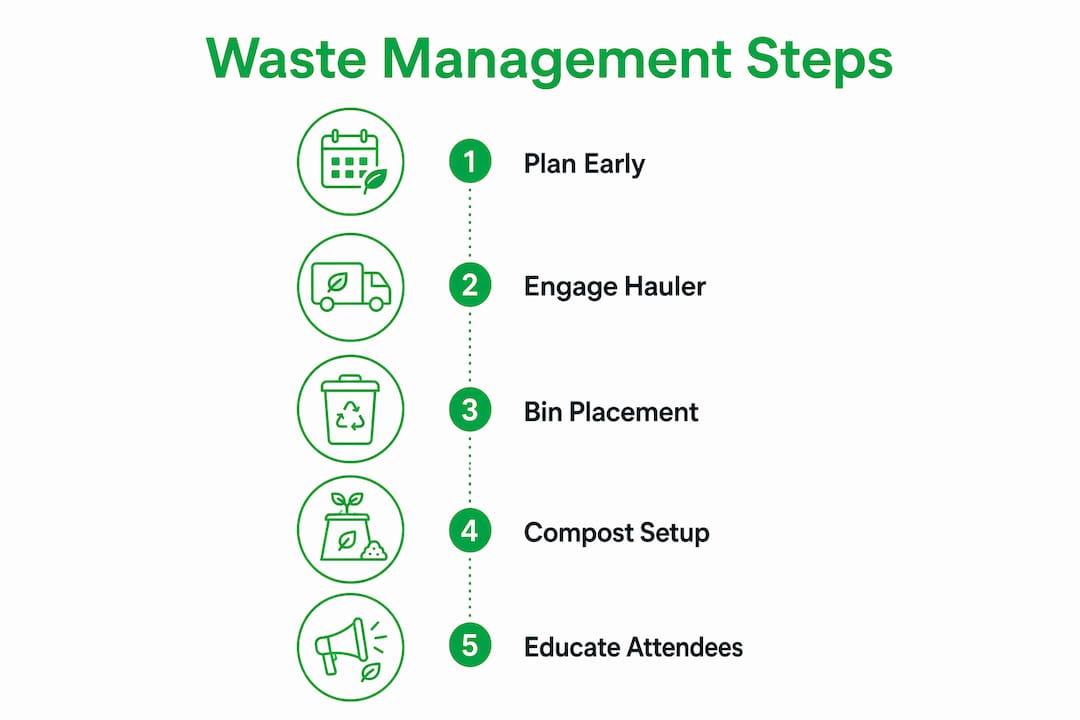
Waste management is a core operational detail, not an afterthought. Treating it as one means building it into your contracts, timelines, and vendor briefs from day one.
Follow these steps to build a plan that holds up on event day:
- Engage all stakeholders early. Bring together event organisers, venue management, food vendors, and your waste hauler before procurement begins. Proactive involvement of waste partners at this stage aligns sustainability goals and prevents last-minute logistics gaps.
- Assess your waste streams. Estimate the volume and composition of waste your event will generate. Factor in food service, merchandise, packaging, and back-of-house vendor materials.
- Set measurable targets. Define a diversion rate goal and assign responsibility for tracking it.
- Design your collection infrastructure. Map bin station locations across the venue. Group recycling, composting, and landfill bins together with clear, colour-coded signage. Never place standalone bins.
- Write vendor requirements into contracts. Require vendors to use compostable or recyclable packaging, separate their own back-of-house waste, and comply with your event’s waste policy.
- Train staff and brief attendees. Run a pre-event briefing for all waste station volunteers. Use signage, social media, and event apps to communicate sorting rules to attendees before they arrive.
Pro Tip: Engage your waste hauler during the procurement phase, not the week before the event. Early alignment on bin types, collection schedules, and diversion targets prevents costly last-minute changes.
California’s AB 2176 requires events with over 2,000 participants to develop a formal waste plan including recycling and reduction strategies. While this is a US regulation, Australian state and local councils are moving in the same direction, with many now requiring waste management documentation for event permits.
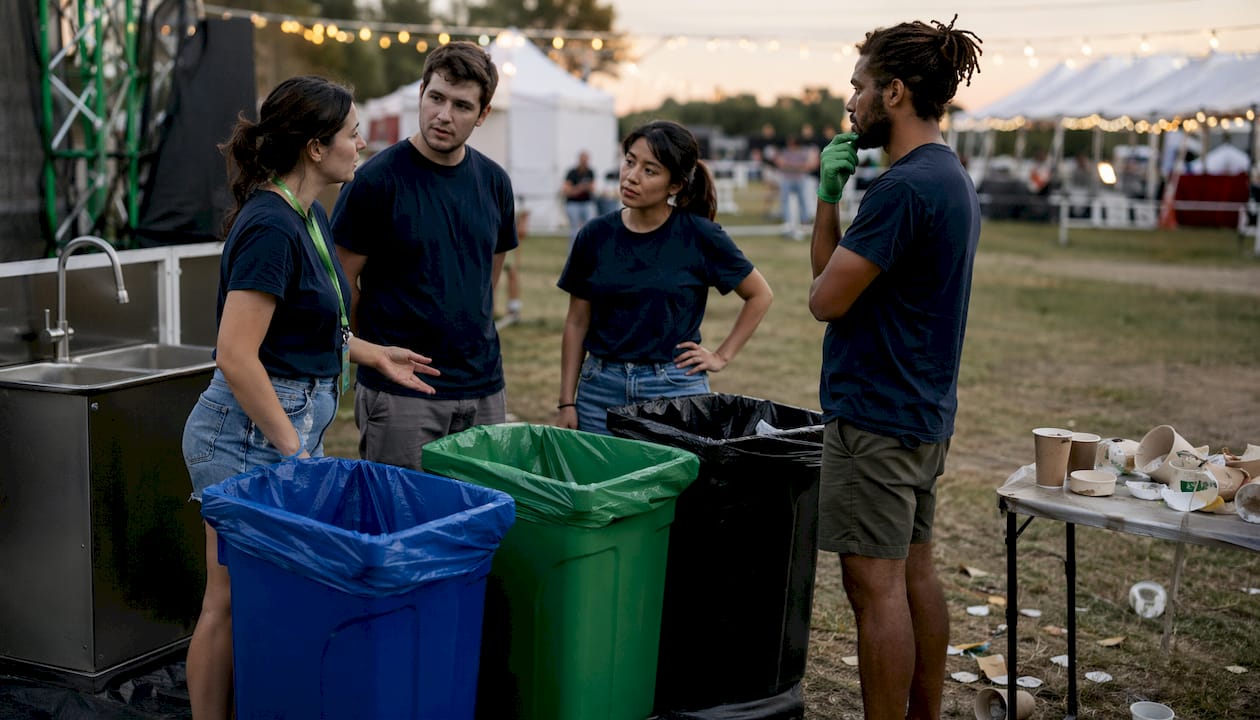
Best practices for waste minimisation and recycling at events
The 4Rs framework (Refuse, Reduce, Reuse, Recycle) gives you a practical decision hierarchy for every purchasing and operational choice at your event.
- Refuse single-use plastics upfront. Engaging vendors to eliminate unnecessary single-use items before the event is far more effective than sorting waste after it’s generated.
- Reduce printed materials, excess packaging, and individually wrapped items. Go digital for programs, schedules, and signage where possible.
- Reuse equipment, tableware, and promotional materials across events. Renting rather than buying tableware alone cuts waste volume considerably.
- Recycle by setting up properly clustered bin stations. Bin contamination drops when bins are grouped and clearly labelled, which keeps disposal fees lower and diversion rates higher.
Statistic callout: A minimal recycling program at events can reduce total waste disposal costs by at least 20%, according to the EPA’s 2026 Special Event Best Practices Guide.
For food and organic waste specifically, plan for composting collection from the start. Line compost bins with certified compostable bags (not standard plastic), and work with vendors to separate fruit, vegetable, and food-soiled paper waste at the source. If your event exceeds 2,000 attendees, consider partnering with a food recovery organisation to redirect surplus food rather than sending it to landfill.
Avoiding common event setup mistakes during the planning phase, including poor bin placement and inadequate waste station staffing, prevents the most expensive and visible failures on event day.
Which Australian providers specialise in event waste management?
Four providers stand out for event-specific waste and sustainability services across Australia. Each takes a different approach, so the right fit depends on your event type, scale, and sustainability goals.
| Provider | Service Offerings | Specialisations | Geographic Coverage | Sustainability Focus | Rating |
|---|---|---|---|---|---|
| Corio Waste Management | Integrated waste, recycling, organics composting, hazardous waste | Government, commercial, hospitality events | Victoria and surrounding regions | Organics composting, tailored recycling programs | 4.4★ (8 reviews) |
| Ace Waste Melbourne | General waste, clinical and hazardous waste disposal | Healthcare, retail, events with clinical waste needs | Melbourne metro and surrounds | Certified compliant handling of dangerous materials | 4.6★ (7 reviews) |
| Waste Sense | General waste, recycling, multi-site brokerage | Multi-site businesses, cost-focused events | Nationwide | Competitive pricing via vetted disposal partnerships | 4.2★ (5 reviews) |
| Closed Loop - Circular Economy Solutions | Circular economy consulting, sustainable site waste, organics management | Events and venues seeking zero-waste outcomes | Australia and New Zealand | Circular economy advisory, measurable environmental outcomes | 5★ (1 review) |
Corio Waste Management is a family-owned provider with a genuinely integrated service model covering organics composting, hazardous waste, and tailored recycling programs. For event organisers in the government, commercial, or hospitality sectors who need a single provider to handle multiple waste streams, Corio’s depth of service is hard to match.
Ace Waste Melbourne has operated since 1987 and carries certifications for clinical and hazardous waste handling. If your event includes a medical tent, food preparation areas with grease waste, or any materials requiring secure chain-of-custody disposal, Ace Waste’s trained team covers that gap. General event waste is also within their scope.
Waste Sense operates as a nationwide broker, connecting clients with vetted disposal companies to deliver competitive pricing across general waste and recycling. For event managers running multiple sites or recurring events who prioritise cost control, Waste Sense’s model offers flexibility without locking you into a single hauler.
Closed Loop - Circular Economy Solutions specialises in circular economy consulting and sustainable site waste management for events across Australia and New Zealand. If your brief includes measurable zero-waste targets, post-event reporting, or a commitment to circular economy principles, Closed Loop brings the advisory depth to make those goals achievable rather than aspirational.
How to choose the right waste management partner for your event
Choosing a provider comes down to matching their actual capabilities to your event’s specific waste challenges, not just their marketing claims.
Work through this checklist before signing any contract:
- Certifications and compliance: Does the provider hold relevant EPA or state authority certifications? Are their staff trained for the specific waste streams your event generates, including hazardous or clinical materials if applicable?
- Event-specific experience: Have they managed waste at events of your scale and type? Ask for documented diversion rates from comparable events.
- Service flexibility: Can they supply the right bin types, collection frequency, and back-of-house sorting support your venue requires?
- Sustainability commitments: Do they offer composting, organics diversion, and recycling reporting, or only general waste removal?
- Contract clarity: Are waste diversion targets, reporting obligations, and post-event data included in the written agreement?
Pro Tip: For multi-site or recurring events, verify that your provider’s geographic coverage and response times work across all locations before committing. A provider who’s excellent in Melbourne may not have the same capacity in regional Victoria.
Follow these steps when evaluating providers:
- Request references from at least two comparable events they’ve serviced.
- Ask for a sample post-event waste report to assess the quality of their measurement and reporting.
- Confirm their process for handling hazardous waste streams, even if you don’t expect them, since events often generate unexpected materials.
- Review their staff training protocols and ask who supervises waste sorting on the day.
- Check that their contract addresses what happens if diversion targets aren’t met.
Understanding the environmental impact of improper disposal also helps you ask better questions during provider selection, particularly around landfill diversion and contamination risks.
Localskipbinhire offers a practical option for event skip bin needs
The providers compared above are full-service waste management companies best suited to events needing ongoing contracts, specialised compliance, or circular economy consulting. If your event’s primary need is straightforward waste collection, Localskipbinhire offers a different and often faster route.
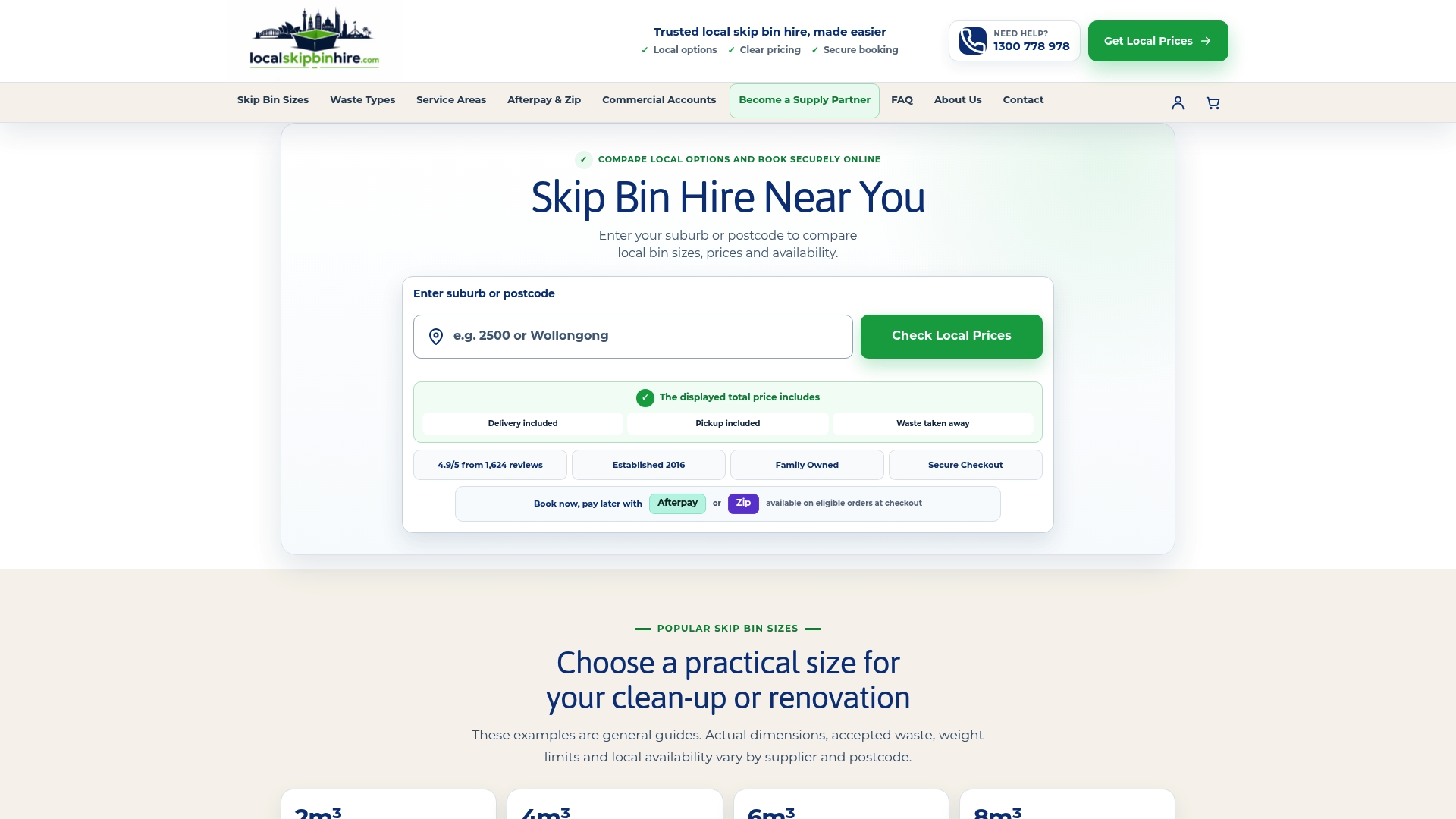
Localskipbinhire connects you with local, independent skip bin suppliers matched to your postcode, with all-inclusive pricing covering delivery, pickup, and disposal. For event organisers who need a larger capacity skip bin for general event waste without the overhead of a full-service contract, the platform makes it easy to compare options, check availability, and book in minutes. With years of hands-on experience since 2016 and suppliers across Australian metro and regional areas, it’s a practical complement to your broader waste plan, especially for post-event cleanups or overflow capacity.
What the site's postcode does to the price
Event sites sit where the space is — showgrounds, reserves, the edge of town — and that is where prices move most. Two neighbouring Queensland postcodes, checked August 2026: an 8m³ bin at Amberley, 4306 is $844, while at Harrisville, 4307 the same bin is $1,021. The 4m³ runs $519 against $582. Nothing about the event changes between those two addresses; the run to the transfer station does. Budget against the postcode the bins are actually going to rather than the nearest city, and where a site has no street number, price the closest delivery postcode in the checker and confirm access at the same time.
Key Takeaways
Effective event waste management starts with planning before waste is generated, not after, and requires clear roles, vendor accountability, and measurable diversion targets.
| Point | Details |
|---|---|
| Plan before procurement | Engage waste partners and set diversion targets before vendors are booked or contracts signed. |
| Use the 4Rs framework | Apply Refuse, Reduce, Reuse, Recycle in order to cut waste at the source before sorting becomes necessary. |
| Recycling saves money | A minimal recycling program can reduce total waste disposal costs by at least 20%, per the EPA’s 2026 guide. |
| Match provider to event type | Choose between full-service providers like Corio or Closed Loop for complex events, or Ace Waste for clinical waste needs. |
| Localskipbinhire for skip bin hire | For straightforward event waste collection, Localskipbinhire offers postcode-matched skip bins with transparent, all-inclusive pricing. |
Recommended
- Renovation Waste Management: The Playbook That Saves Real Money – Local Skip Bin Hire
- The Environmental Impact of Improper Waste Disposal and How to Avoid I – Local Skip Bin Hire
- A Guide to Hazardous Waste Disposal and How Our Skip Bins Can Assist. – Local Skip Bin Hire
- How to Avoid the All Too Common Skip Bin Nightmares – Local Skip Bin Hire
← Older Post Newer Post →