

Skip Bin Contamination Charges: What Australians Need to Know
Brett Taylor en skip bin contamination charges
Skip bin contamination charges are extra fees applied when a bin contains material that should have been separated, is prohibited, or requires special handling at the receiving facility. If you’ve just received an unexpected invoice, stop loading the bin immediately, photograph the current contents, and call your supplier to request a weighbridge ticket or facility rejection note. Key terms to watch for in any quote or terms sheet include excess weight, contamination fee, prohibited item fee, re-handling, and gate fee. Acting fast with documentation gives you the best chance of disputing a charge you believe is unfair.
Quick action checklist:
- Stop adding waste to the bin the moment you suspect a problem
- Photograph the bin contents from multiple angles with timestamps
- Note exactly what was loaded and when
- Contact your supplier and request a weighbridge ticket or facility rejection photo
- Keep your original booking quote and terms for comparison
Key Takeaways
Contamination charges are almost always preventable: declare your waste type accurately, choose the right bin, and keep prohibited items out of the load entirely.
| Point | Details |
|---|---|
| What triggers a charge | Mixed waste streams, prohibited items, excess weight, or liquids in a dry-waste bin all cause contamination fees. |
| Typical fee ranges | Excess weight runs typical excess weight charges per unit of overage; contamination surcharges typically range from typical contamination surcharges per incident. |
| Top prevention step | Declare your waste type at booking and choose a dedicated bin (green waste, heavy waste, general) for your dominant material. |
| Dispute evidence | Always request a weighbridge ticket, facility rejection photo, and itemized invoice before paying any unexpected charge. |
| Localskipbinhire | Postcode-matched suppliers with clear inclusions and bin types displayed upfront reduce the risk of surprise fees at collection. |
Table of Contents
- What counts as contamination and who decides when a charge applies
- How suppliers and facilities calculate extra charges
- Which items most commonly cause contamination charges in Australia
- Concrete steps to avoid contamination charges before and during your hire
- What to do if your skip is charged for contamination or the load is rejected
- Why clarity at booking is worth more than any dispute process
- Clear pricing and the right bin, before the truck arrives
- Sources
What counts as contamination and who decides when a charge applies
Contamination, in skip bin terms, means your load contains something that shouldn’t be there given the bin type you hired. That could be a prohibited item, a mixed waste stream when a dedicated stream was required, or organic soiling and liquids that make otherwise recyclable material unprocessable. Food or liquids on paper and cardboard, for example, can render an entire recycling load unsalvageable at the processing facility.
The decision to charge usually involves more than one party. Your skip supplier sets pre-delivery rules in their terms and conditions. The receiving facility or transfer station gate operator physically inspects loads on arrival and can reject or surcharge a load on the spot. Local council and EPA rules then sit above both, governing what can legally be accepted at licensed facilities in your region.
Common trigger scenarios include:
- Green waste mixed into a general waste bin
- Food-soiled cardboard or paper in a recycling load
- Liquids, paint, or chemical drums mixed with dry waste
- Mattresses, tyres, or batteries placed in a general skip
- Electronic waste (e-waste) mixed with household rubbish
Asbestos is treated as a special case across all Australian states. Even suspect asbestos-containing material (ACM) triggers immediate rejection at most transfer stations and requires licensed removal and disposal under state EPA regulations. If you find material you think might be asbestos, stop loading, cover the area, and contact a licensed asbestos removalist before the bin is collected.
How suppliers and facilities calculate extra charges
Understanding the charging levers helps you predict what an unexpected invoice might look like before it arrives.
Common fee types
Most quotes include an allowed weight for the bin size and waste type declared. Exceed that weight, or deliver a load that doesn’t match the declared stream, and additional charges stack on top of the base hire price. Australian skip hire rates vary by state and waste type, with per-cubic-metre rates ranging from around $50/m³ in Queensland to approximately $89/m³ in New South Wales. Contamination fees are charged on top of those base rates.
Suppliers and transfer stations use weighbridge tickets as the primary evidence for excess-weight and contamination charges. Historical disposal cost data shows that contaminated or special-category waste streams attract significantly higher per-tonne disposal costs than clean general waste, which is why a single prohibited item can push a load into a much more expensive disposal category.
| Fee Type | Typical Charging Unit | Representative Range (AUD) |
|---|---|---|
| Excess weight | Per 100 kg or per tonne over allowance | typical excess weight charges per unit of overage |
| Contamination/disposal surcharge | Per incident or per tonne | typical contamination surcharges per incident |
| Cleaning or re-handling | Per load or per hour | typical cleaning or re-handling fees per load |
| Rejected load fee | Per load (return transport + reprocessing) | typical rejected load fees per load including return transport and reprocessing |
| Council/permit fee (public land) | Per day or per placement | typical council or permit fees per day or placement |
Ranges are representative industry examples. Actual charges vary by supplier, state, and facility. Always request a written fee schedule before booking.
What evidence to ask for
If you receive a contamination charge, request these documents from your supplier:
- Weighbridge ticket showing the load weight at the receiving facility
- Facility rejection note or gate photo showing the offending material
- Itemized disposal invoice from the transfer station
- Written breakdown of how the surcharge was calculated
For council permit fees, a guide to skip bin placement permits in Australia explains when a permit is required and what councils typically charge.
Which items most commonly cause contamination charges in Australia
Knowing the high-risk items before you start loading is the most reliable way to avoid fees. The most common contaminants found in recycling and general waste collections include food, liquids, Styrofoam, and textiles. In a skip bin context, the list of problem items is broader.
High-risk items and why they cause charges:
- Asbestos or suspect ACM: Legally restricted; requires licensed disposal. Triggers immediate rejection and regulated handling costs.
- Liquids and paint: Contaminate dry loads and create hazardous waste classification issues at the facility.
- Batteries (all types): Fire risk in compaction vehicles and landfill; many facilities refuse them outright.
- Tyres: Banned from landfill in most Australian states; require separate tyre disposal through licensed channels.
- Chemicals and solvents: Hazardous classification triggers special handling and disposal costs.
- Mattresses: Bulky and difficult to compact; many facilities charge a per-item fee or refuse them in mixed loads.
- Green waste in a general waste bin: Green waste is often diverted to composting facilities; mixing it with general waste destroys that diversion value and attracts a higher disposal rate.
- E-waste (electronics): Banned from landfill in several states; must go through licensed e-waste processors.
- Food-soiled cardboard or paper: Renders recyclable paper streams unprocessable, as recycling contamination guidance confirms.
- Hazardous building materials: Treated timber, lead-based paint waste, and fibrous insulation can all trigger special-waste classification.
Check your local council or state EPA website for region-specific prohibitions. Rules differ between states, and some materials accepted in one jurisdiction are banned in another. The NSW EPA, VicEPA, and Queensland’s Department of Environment each publish current accepted-waste lists for licensed facilities.
For a full breakdown of what can and can’t go in a skip in Australia, the permitted and prohibited items guide covers the rules by waste category.
Concrete steps to avoid contamination charges before and during your hire
Prevention is far cheaper than disputing a charge after the fact. Declaring the correct waste stream at booking and choosing the right bin type for your dominant material are the two highest-impact steps you can take.
Before you book:
- Declare your waste type accurately. If you’re doing a garden cleanout, book a green waste bin, not a general waste bin.
- Choose a bin sized for your dominant material. A heavy waste bin is the right call for concrete or soil; a general waste bin is not.
- Ask your supplier for a written list of prohibited items, the included weight allowance, and the excess-weight rate per 100 kg or tonne.
- Request a written schedule of all additional fees before you confirm the booking.
While loading:
- Sort as you go. Keep green waste, metals, and recyclables in separate piles before they go in the bin.
- Bag or box small, dusty, or light items to prevent them shifting and mixing with heavier material.
- Never put liquids, paint tins, or chemical drums in a skip, even if they appear empty.
- Take photos as you load, especially if you’re handling mixed renovation waste.
When in doubt, use a dedicated bin. If you have both green waste and general rubbish, hiring two smaller bins for the separate streams almost always costs less than the contamination surcharge on a mixed load. Loading tips for mixed renovation waste walk through exactly this scenario.
Questions to ask your supplier before booking:
- What weight is included in the quoted price?
- What is your excess-weight rate per 100 kg?
- Can you give me a written list of prohibited items for this bin type?
- If a contamination charge is applied, what evidence will you provide?
- Are council permit fees included, or are they billed separately?
Pro Tip: Put heavy items like tiles, bricks, and soil at the bottom of the bin first. Weight concentrated at the top can cause load instability during transport, which sometimes triggers a re-handling fee at the facility even when the waste itself is clean.
What to do if your skip is charged for contamination or the load is rejected
Getting an unexpected charge doesn’t mean you have to pay it without question. A clear paper trail gives you real leverage.
Immediate steps:
- Photograph the bin contents before collection if you haven’t already.
- Request the facility’s rejection note or gate photo from your supplier.
- Ask for the weighbridge ticket showing the load weight.
- Request an itemized invoice that breaks down every line of the charge.
- Pull out your original booking confirmation and terms sheet.
Dispute checklist:
- Compare the supplier’s evidence (weighbridge ticket, photos) against your own load photos.
- Check whether the prohibited item was actually present at the time of collection, not added afterward.
- Verify the excess weight calculation against the included allowance in your original quote.
- Ask for the transfer station’s own invoice to confirm the disposal cost passed on to you.
Escalation path in Australia:
- Supplier resolution first. Contact your supplier in writing, attach your evidence, and request an internal review. Most legitimate charges are resolved at this stage.
- Request the transfer station invoice. If the supplier can’t produce the facility’s own paperwork, the charge is harder to justify.
- Escalate to the booking platform. If you booked through a marketplace, raise a dispute through their process.
- Consumer protection agencies. If you believe the charge is unfair or the supplier has breached the contract, lodge a complaint with your state’s fair trading office: NSW Fair Trading, Consumer Affairs Victoria, Queensland’s Office of Fair Trading, or the equivalent in your state.
Documents to retain for any dispute:
- Timestamped photos of the bin contents at loading and at collection
- Original booking confirmation and terms and conditions
- Weighbridge ticket from the receiving facility
- Itemized charge invoice
- Any written or email communication with the supplier
Weighbridge tickets and facility gate photos are industry-standard proof. Customers who request and retain these documents are consistently better positioned in billing disputes.
Why clarity at booking is worth more than any dispute process
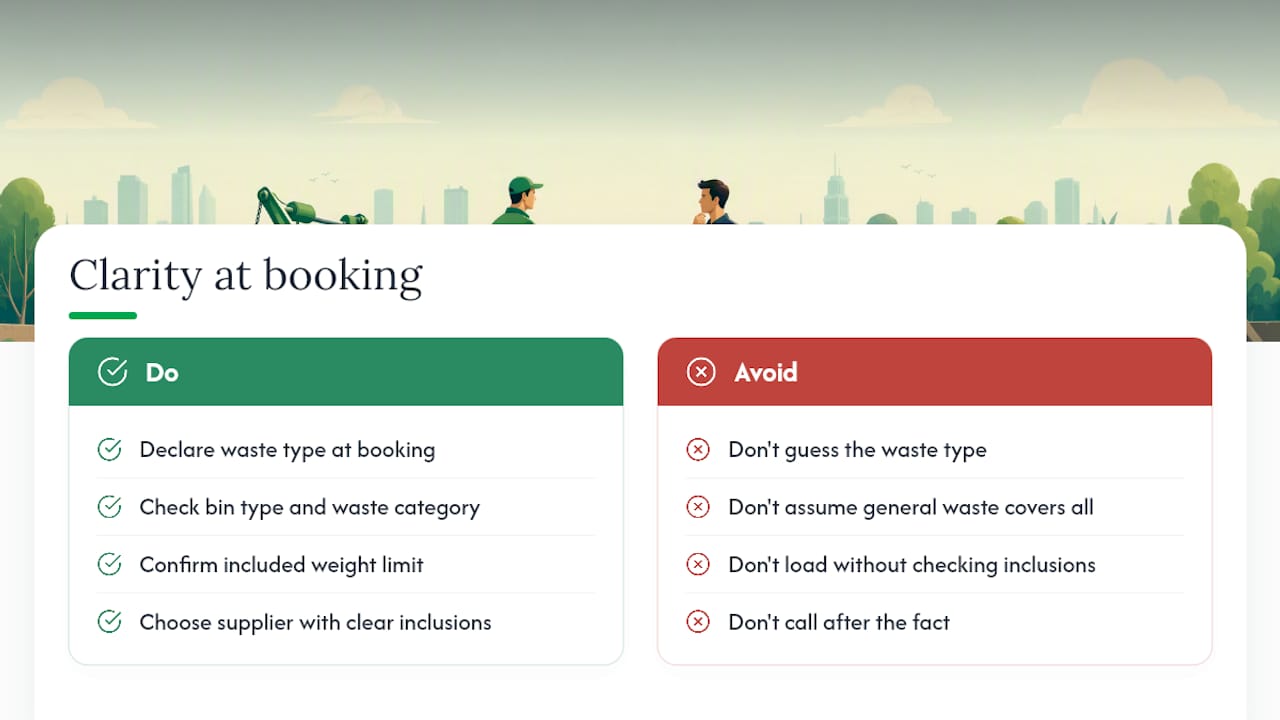
The pattern I see repeatedly is this: customers who spend two minutes declaring their waste type accurately at booking almost never end up in a contamination dispute. Customers who guess, or who assume a general waste bin covers everything, are the ones calling suppliers after the fact.
Transparent quotes, clear waste-type definitions, and a simple photo record reduce disputes for both customers and suppliers. When a supplier knows exactly what stream they’re collecting, they can match the load to the right receiving facility and price it correctly from the start. When a customer knows the included weight and the prohibited items list before they load a single bag, they make better decisions on site.
Localskipbinhire addresses this directly through postcode-matched supplier matching and clear inclusions displayed at the quote stage. Customers can see the bin type, the waste category, and the included weight before they confirm. That transparency doesn’t eliminate every possible charge, but it removes the ambiguity that causes most of them.
The dispute process exists for genuine errors. But the better outcome, every time, is a booking where the waste type is declared correctly, the right bin is chosen, and the supplier and customer are aligned before the bin is delivered.
Clear pricing and the right bin, before the truck arrives
Unexpected contamination fees usually come down to one thing: a mismatch between what was declared at booking and what ended up in the bin. Localskipbinhire removes that mismatch by connecting you with postcode-matched local suppliers who display bin types, waste categories, and included weight allowances upfront, so you know exactly what you’re getting before you confirm.
Whether you’re clearing a garden, managing a renovation, or handling a construction cleanout, you can compare local skip bin prices and book the right bin for your waste type in minutes. No guessing on weight limits. No surprise prohibited-item fees. Just a clear quote, the correct bin, and a local supplier who knows your area’s disposal rules. Check availability at your postcode and book a 4m³ skip bin or the size that fits your job today.
Sources
- How Much Does Skip Bin Hire Cost? 2026
- Recycling contamination | Waste and recycling - Hampshire County Council
- Know Your Contaminants | Clean & Green Singapore
- C:\MyFiles\Trash\Cost_compendium.wpd
Recommended
- Skip Bin Hire in New South Wales: What You Need to Know – Local Skip Bin Hire
- Skip Bin Hire Brisbane and Moreton Bay: What to Know Before You Book – Local Skip Bin Hire
- What Can (and Can’t) Go in a Skip Bin in Australia – Local Skip Bin Hire
- Skip Bin Prices You Need To Know About – Local Skip Bin Hire
Know your base rate before you start loading
A contamination surcharge arrives after the load is tipped. The hire fee does not: it is a firm figure for your address and bin size, quotable before the truck is booked. Write it down, because it is the baseline any later invoice has to be justified against. Three of our suburb pages, checked August 2026:
| Suburb | 2m³ | 4m³ |
|---|---|---|
| Springwood, NSW 2777 | $360 | $568 |
| Clarkefield, VIC 3430 | $279 | $423 |
| Mount Compass, SA 5210 | $285 | $432 |
Those are general-waste listings on the day, not fixed quotes. Green waste, soil, brick and plasterboard are priced as separate streams in the live checker, so run the stream you will actually be filling — a rate you have on paper is far easier to defend than one you assumed.
← Older Post Newer Post →