

How much does rubbish removal cost in Australia?
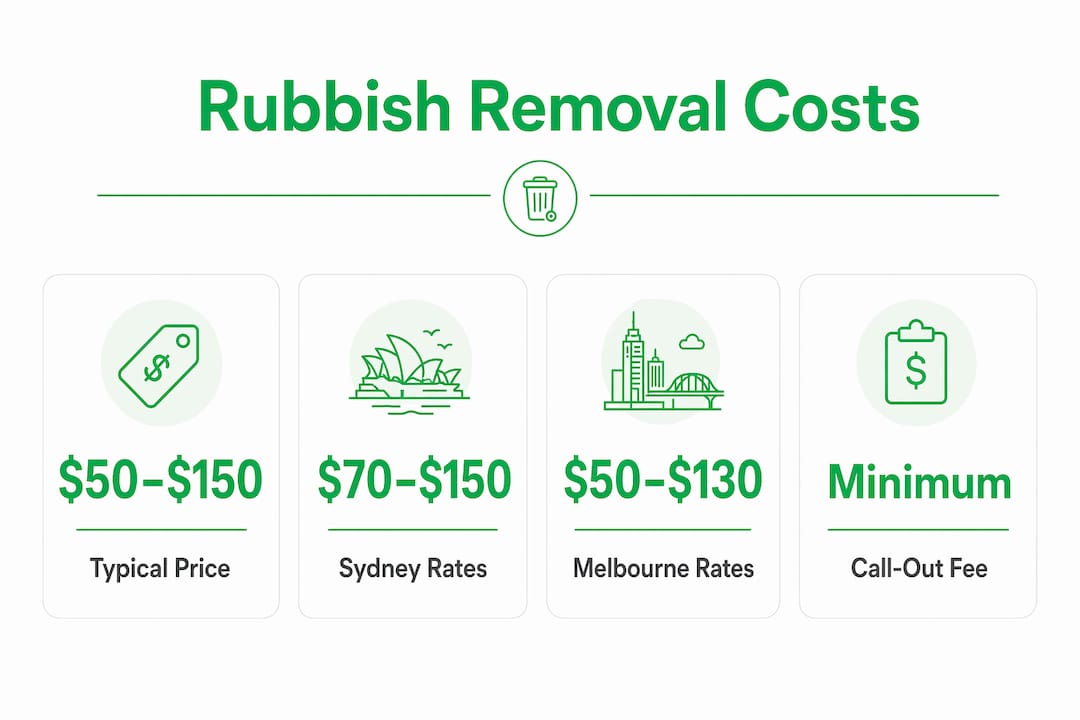
Rubbish removal in Australia generally costs in a moderate range per cubic metre, depending on the type of waste and location. That range covers most standard residential jobs, but the final price shifts considerably once you factor in waste category, access, and your local area’s landfill levies.
Here’s a quick snapshot of typical price differences by waste type, with hazardous or mixed loads costing more due to special handling and disposal fees.
Most services also carry a minimum call-out charge, so even a small load will cost something. Full truckload pricing is available for larger jobs and often brings the per-cubic-metre rate down. If you’re clearing out after a renovation or doing a full house cleanout, booking a larger load is usually the smarter financial move.
Table of Contents
- How rubbish removal prices vary across Australian cities
- What actually drives the cost of rubbish removal?
- What types of rubbish get removed and how they’re disposed of
- Legal and regulatory considerations you should know about
- Questions to ask before you hire a rubbish removal service
- Expert tips for keeping your rubbish removal costs down
- Rubbish removal vs. junk removal: is there a difference?
- Localskipbinhire makes it easy to compare and book
- Key Takeaways
How rubbish removal prices vary across Australian cities
Location plays a bigger role in pricing than most people expect. Landfill levies and transport costs differ from state to state, and those differences flow directly into what you pay. Sydney consistently sits at the higher end of the national range, while Brisbane and Adelaide tend to be more affordable.
| City / Region | Typical Price Range (per m³) |
|---|---|
| Sydney | $70–$150 |
| Melbourne | $50–$130 |
| Brisbane | $50–$100 |
| Perth | $50–$150 |
| Adelaide | $50–$90 |
| Hobart | $50–$90 |
| Canberra | $50–$150 |
Sydney’s higher rates reflect New South Wales’s landfill levy structure, which is among the steepest in the country. Melbourne sits in the middle of the pack, though local government levies in Victoria have been rising steadily. Adelaide and Perth are generally more affordable, partly because transport distances to disposal facilities are shorter in many suburban areas. For a closer look at how levies affect costs in those cities, the Adelaide and Perth guide on Localskipbinhire breaks it down clearly.
What actually drives the cost of rubbish removal?
Volume is the single biggest factor. Larger loads cost more in absolute terms, but the price per cubic metre often drops as the load grows. That’s why consolidating a cleanout into one booking almost always saves money compared to multiple smaller pickups.
Beyond volume, these factors push prices up or down:
- Waste type: Hazardous materials, mixed loads, and heavy construction debris attract higher disposal fees. Sorting waste before collection avoids mixed-load surcharges and keeps costs predictable.
- Labour intensity: Tight hallways, stairs, and hard-to-reach storage areas all add time to the job. That extra time usually means extra charges.
- Travel distance: Remote or regional properties may carry a transport surcharge on top of the base rate.
- Disposal fees: Landfill levies vary by state and are typically passed on to the customer. Always check whether a quote includes tipping fees or adds them separately.
Pro Tip: Sort your rubbish into categories before the crew arrives. Separating green waste, general household items, and heavy materials like bricks or concrete can meaningfully reduce your bill by avoiding mixed-load penalties and cutting down on labour time.
Understanding how skip bin hire prices vary gives you a solid foundation for reading any rubbish removal quote accurately.
What types of rubbish get removed and how they’re disposed of
Most professional rubbish removal services handle a broad range of waste categories, but the disposal method and associated cost differ for each. Knowing what you have before you book helps you get an accurate quote.
Common waste types accepted:
- Household waste: General furniture, appliances, clothing, and everyday clutter. Usually the most straightforward to price and dispose of.
- Green waste: Garden clippings, branches, soil, and lawn trimmings. Often cheaper per cubic metre but bulky by nature.
- Construction and demolition debris: Bricks, concrete, tiles, and timber. Heavy materials that frequently attract weight-based surcharges.
- White goods: Fridges, washing machines, and dryers. These contain refrigerants or other materials requiring special handling, so expect a per-item fee on top of the base rate.
- Furniture: Sofas, mattresses, and bed frames are bulky and labour-intensive to move, which pushes up the cost.
- Hazardous materials: Paints, chemicals, asbestos, and fluorescent tubes. These require specific disposal methods and are priced separately from general loads.
Disposal methods used:
Mixed waste loads increase costs because recyclables must be separated or the entire load goes to landfill, triggering higher landfill levy payments. Reputable services route clean, sorted loads to recycling facilities wherever possible. Council kerbside collection handles routine household waste for free, but it won’t take bulky items, construction debris, or hazardous materials. For those, you need either a council drop-off facility or a licensed commercial removal service.
Legal and regulatory considerations you should know about
Rubbish removal in Australia isn’t just a logistics question. There are real legal obligations attached to how waste is collected, transported, and disposed of.
- Landfill levies: Every state and territory charges a levy on waste sent to landfill. These levies are set by state governments and are regularly reviewed upward. They form part of your disposal fee whether or not the quote spells it out.
- Licensed waste carriers: Waste transporters must hold the appropriate licence for the type of waste they carry. Using an unlicensed operator risks illegal dumping, and the property owner can face penalties if waste is traced back to them.
- Hazardous waste restrictions: Materials like asbestos, lead paint, chemicals, and certain electronics cannot go into general waste streams. They require specialist handling and disposal through approved facilities. Check the government recycling drop-off locator for approved facilities near you.
- Illegal dumping: Fly-tipping carries significant fines in every Australian state. If a quote seems unusually cheap, that’s often a warning sign that the operator plans to dump waste illegally rather than pay legitimate disposal fees.
- Transparency in quotes: A compliant, reputable provider will include all tipping fees and levies in their quote upfront. Hidden disposal fees added after the job are a red flag.
Questions to ask before you hire a rubbish removal service
Getting a few answers before you commit can save you from a nasty surprise on the invoice. Here’s what to ask any provider:
- Is the price fixed or an estimate? Fixed pricing gives you certainty. Estimates can climb if the job takes longer or the load is heavier than expected.
- Are disposal and tipping fees included? Some operators quote labour only and add landfill levies separately. Ask for a fully itemized, all-inclusive price.
- What waste types do you accept? Not every service handles hazardous materials, asbestos, or certain electronics. Confirm your specific items are covered before booking.
- Are there access surcharges? Stairs, narrow driveways, or items in hard-to-reach areas can trigger extra labour fees. Mention any access challenges upfront.
- What are your scheduling options? Same-day and weekend bookings often carry a premium. If your timeline is flexible, booking a few days ahead can reduce the cost.
- Are you licensed and insured? Ask for evidence of their waste carrier licence and public liability insurance. A reputable operator will provide both without hesitation.
- What’s your recycling commitment? A good provider will tell you what percentage of collected waste they divert from landfill and how they handle recyclables.
Expert tips for keeping your rubbish removal costs down
A little preparation before the truck arrives goes a long way toward keeping the bill manageable.

Pro Tip: Book at least two to three days in advance when you can. Same-day rubbish removal typically costs 30–50% more than a standard booking, so a small scheduling adjustment can deliver real savings.
Here’s a practical checklist for smarter rubbish removal budgeting:
- Sort before they arrive. Separate green waste, general household items, and heavy materials like concrete or bricks. Mixed loads cost more because they require additional sorting at the disposal facility.
- Clear a path. Make sure the crew can access your rubbish easily. Removing obstacles reduces labour time and keeps you within the quoted rate.
- Get an itemized quote. Ask for a breakdown that shows labour, disposal fees, and any potential surcharges separately. Transparent pricing means no surprises.
- Avoid weekends and public holidays when possible. Many operators charge a premium for those time slots.
- Consolidate your load. One larger booking is almost always cheaper per cubic metre than two smaller ones. If you’re planning a renovation, read up on renovation waste management to plan your disposal efficiently.
- Compare skip bin hire vs. removal services. For some jobs, a self-load skip bin is significantly cheaper than a full-service removal crew. The skip bin vs. rubbish removal comparison on Localskipbinhire walks through exactly when each option makes financial sense.
Rubbish removal vs. junk removal: is there a difference?
In Australia, the terms “rubbish removal” and “junk removal” are used interchangeably by most homeowners and service providers. Both refer to the collection and disposal of unwanted items from a residential or commercial property.
That said, there’s a subtle distinction worth knowing. “Rubbish removal” tends to describe the broader category, including general waste, green waste, and construction debris. “Junk removal” is more commonly used for household cleanouts involving old furniture, appliances, and accumulated clutter. In practice, most Australian operators offer both under the same service umbrella, and pricing follows the same per-cubic-metre or load-based structure regardless of which term you use. The key variable is always the type and volume of material, not the label applied to the job.
Localskipbinhire makes it easy to compare and book
Knowing the cost of rubbish removal is one thing. Finding a local provider with clear, all-inclusive pricing is another. Localskipbinhire connects you with independent local suppliers matched to your postcode, so you’re comparing real options for your area rather than generic national rates.
Every booking through Localskipbinhire includes delivery, pickup, and disposal in the quoted price. No hidden tipping fees added after the job. No guessing whether the operator is licensed. The platform covers household, garden, construction, commercial, and event waste across metro and regional Australia, with bin sizes ranging from compact 2m³ options to large 10m³ bins for major projects. If you want to spread the cost, flexible payment options are available too.
Check transparent, GST-inclusive pricing for your area and book in minutes.
Key Takeaways
Rubbish removal in Australia typically costs between $50 and $150 per cubic metre, depending on the type of waste and your location. For example, Sydney ranges from $70 to $150 per m³, Melbourne from $50 to $130 per m³, Brisbane from $50 to $100 per m³, and Adelaide and Hobart from $50 to $90 per m³. Sorting waste before collection is the single most effective way to reduce your bill.
| Point | Details |
|---|---|
| Typical cost range | Typical rubbish removal costs are between $50 and $150 per m³, with pricing depending on waste type and city. |
| City price differences | Sydney runs $70–$150/m³; Melbourne $50–$130/m³; Brisbane $50–$100/m³; Adelaide and Hobart $50–$90/m³. |
| Biggest cost driver | Volume is the primary factor; larger loads reduce the per-cubic-metre rate. |
| Same-day premium | Booking same-day service costs 30–50% more than scheduling 2–3 days ahead. |
| Localskipbinhire | Compare and book local skip bins with all-inclusive, transparent pricing matched to your postcode. |