

6 Household Waste Disposal Options Australian Homes Can Use Today
Brett Taylor en household waste disposal options
Most Australian households can cover nearly all of their waste through five paths: kerbside general, recycling, and organics bins, council bulky collections, hazardous and e-waste drop-offs, and private skip bin hire or removal for anything oversized or mixed. The right first move is simple: check your council’s accepted-items list for anything unusual, and book a private removal or skip bin the moment a load is too big, too mixed, or too urgent for kerbside.
TL;DR:
- Checking your council’s accepted-items list is essential to avoid contamination and ensure proper disposal of hazardous, e-waste, or large items.
- Food scraps should be placed in green organics bins or composted at home, with FOGO collections available to divert organic waste from landfill.
- Private skip bin hire or removal is cheaper and more practical for volume-heavy jobs, oversized, or mixed waste that exceed council limits.
- Hazardous household waste, including batteries, paint, and e-waste, must go to specialized drop-off points or collection events for safety and environmental reasons.
- The most effective waste reduction move is accurate knowledge of local rules, as service offerings and accepted items vary greatly between councils.
Table of Contents
- Household Disposal Options at a Glance
- Kerbside Bins: What Goes in Red, Yellow, and Green
- Composting, Worm Farms, and Council FOGO Collections
- Hazardous Household Waste and E-Waste Drop-Off Points
- Bulky Waste and Hard Rubbish: Council Rules vs. Private Removal
- When to Hire a Skip Bin or Book Private Rubbish Removal
- Prep, Packing, and Avoiding Contamination
- What Actually Moves the Needle on Household Waste
- Where to Check the Rules Yourself
- Book the Right Bin Once You Know What You’re Clearing
- Sources
Household Disposal Options at a Glance
Working out where something goes shouldn’t take a phone call to three different departments. Most items fall into one of six paths, and matching the item to the path is the whole game.
- Kitchen scraps and food waste: green organics bin if your council runs a FOGO service, otherwise home compost or worm farm.
- Bottles, tins, cardboard: yellow recycling bin, rinsed and dry.
- Garden clippings and branches: green bin, council garden-organics collection, or a skip bin for a big prune.
- Mattresses, furniture, whitegoods: council bulky waste booking or private rubbish removal.
- Batteries, paint, chemicals: hazardous waste drop-off or a chemical cleanout event, never the kerbside bin.
- TVs, computers, printers: e-waste drop-off points under national stewardship schemes.
Council bulky collections work well for a single wardrobe or an old couch once or twice a year; alternatively, you can explore how to give away unwanted furniture to find new homes for items in good condition. Private removal or skip bin hire earns its cost when you’ve got a garage full of mixed junk, a tight deadline, or items councils won’t take, such as construction offcuts or full trailer loads. Always double check accepted items with your council first. The Australian Government’s recycling guidance notes that rules and services vary significantly between councils, so what your neighbor’s council collects free might not apply to you at all.
Kerbside Bins: What Goes in Red, Yellow, and Green
Australia’s kerbside system runs on three core streams, and Logan City Council’s breakdown of accepted and excluded items reflects the pattern most councils follow: general waste (usually red lid), recycling (yellow lid), and organics or green waste (green lid). Names shift a little between states, but the color logic is close to universal.
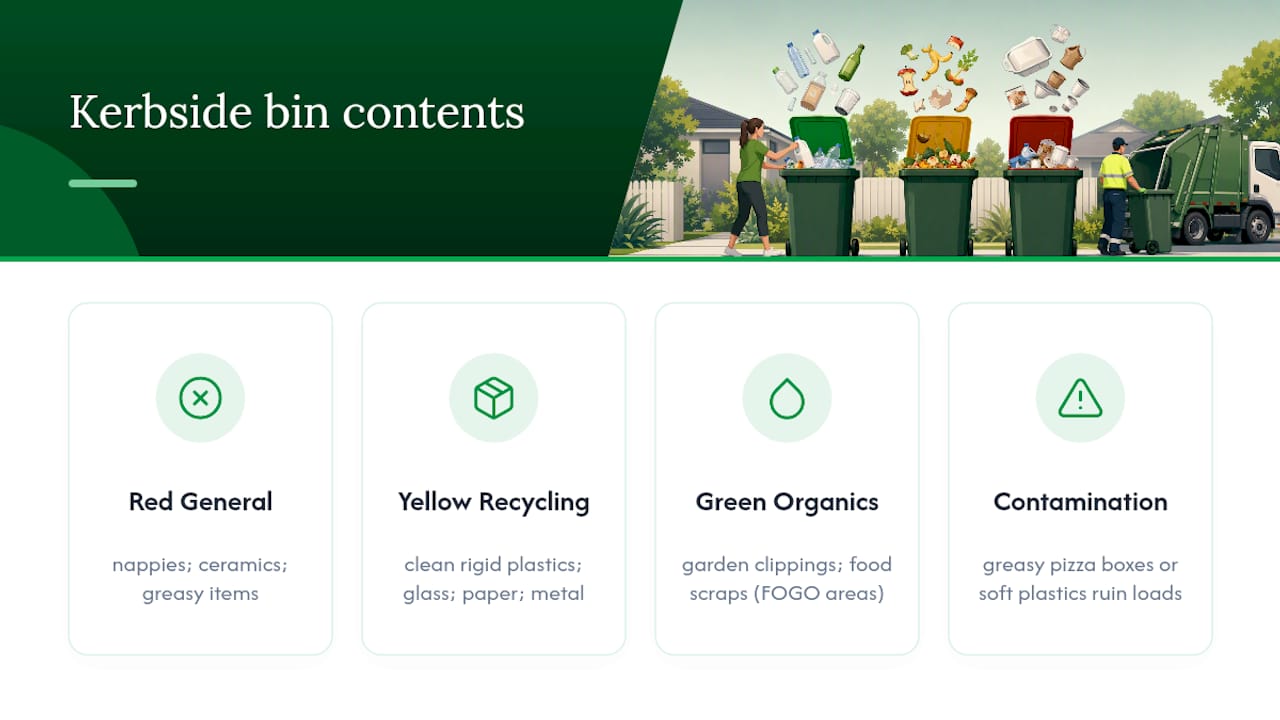
The red/general bin takes non-recyclable household rubbish: food packaging that can’t be cleaned, broken ceramics, nappies, and anything contaminated with food or grease. The yellow/recycling bin takes rigid plastics, glass, paper, cardboard, and metal tins and cans, provided they’re empty and reasonably clean. The green bin takes garden clippings and, in councils with FOGO (Food Organics, Garden Organics) services, food scraps too.
Contamination is the quiet killer of recycling programs. A single greasy pizza box or a bag of soft plastics tossed into the yellow bin can force a whole truckload to be rejected and redirected to landfill, since sorting facilities can’t safely separate wet or tangled material once it’s mixed in. A quick rinse of a jar or an empty milk carton takes seconds and keeps the whole load usable.
Pro Tip: Soft plastics like bread bags and cling wrap almost never belong in kerbside recycling. Most supermarkets run separate soft plastic drop-off points, so keep a bag by the pantry and take it in on your next shop.
Because collection days, bin colors, and accepted items differ by council, it’s worth bookmarking Planet Ark’s RecyclingNearYou tool or checking your council’s own site before you guess.
Composting, Worm Farms, and Council FOGO Collections
Organic waste is the heavyweight of the household bin, and it’s also the easiest to divert. Households generated roughly 6.4 million tonnes of organic waste in 2018–19, and every kilo that goes to composting instead of landfill cuts the methane a rotting scrap heap would otherwise produce underground.
You’ve got real choices depending on your space and patience:
- Backyard compost bins: suit houses with a garden bed to feed; need turning every week or two.
- Worm farms: compact, good for units and courtyards, but slower with citrus and onion.
- Bokashi buckets: ferment scraps indoors in a sealed bucket, ideal for apartments with no outdoor space.
- Small dehydrators: fastest turnaround, higher upfront cost, no smell or pests.
- Council FOGO collections: put food and garden waste straight in the green bin, no maintenance required.
Diversion at scale: as of March 2023, only about 27% of local governments had rolled out a full FOGO kerbside service, with another 16% running garden-organics-only collections. If your council isn’t in that 27%, a bokashi bucket or worm farm does the same job at home.
Pest and odor control comes down to basics: bury fresh scraps under a layer of dry leaves or shredded paper, keep meat and dairy out of backyard compost, and empty kitchen caddies every couple of days rather than letting them sit.
Hazardous Household Waste and E-Waste Drop-Off Points
Some items are flatly banned from every kerbside bin, and for good reason. Batteries can spark fires in collection trucks. Paint and solvents contaminate recycling loads. Gas bottles and pesticides are outright dangerous to handlers.
Items that should never go in a kerbside bin include:
- Household batteries and power tool batteries
- Paint, paint thinners, and solvents
- Motor oil and automotive fluids
- Compact fluorescent globes (CFLs) and fluorescent tubes
- Pesticides, herbicides, and garden chemicals
- Expired or unused medicines
- Gas bottles and gas cylinders
- TVs, computers, printers, and other e-waste
“Chemicals, batteries and electronic devices need to go to a place that’s set up to handle them safely; putting them in with regular rubbish can be dangerous for waste workers and contaminate recycling loads.” This principle sits behind the Australian Government’s guidance on reducing waste, which points households to hazardous drop-off centres and dedicated collection events rather than kerbside bins.
Take household chemicals to a community recycling centre or a ChemClear/Chemical CleanOut event when one runs in your area. Paint goes to a PaintBack drop-off point, found at many hardware stores and waste facilities. E-waste like TVs and computers falls under the National Television and Computer Recycling Scheme, run through TechCollect drop-off sites. Keep chemicals in their original containers with lids sealed, and separate batteries from everything else before you transport them.
Bulky Waste and Hard Rubbish: Council Rules vs. Private Removal
Big items need a bigger decision than “which bin.” Most councils run a bookable bulky waste service with real limits attached, and knowing those limits before you call saves a wasted trip.
- Check your entitlement. The ACT Government’s free bulky waste service allows up to 2 cubic metres per household per financial year, a pattern echoed by councils like Lake Macquarie with their own volume caps and accepted-item lists.
- Read the exclusion list. Most council services reject hazardous items, construction waste, tires, and gas bottles outright, so check before you drag the pile to the curb.
- Book ahead. Bulky collections typically need scheduling days or weeks out, unlike a skip bin you can have delivered within a day or two.
- Weigh urgency against volume. A single collection often works for one bulky item; a garage clean out, hoarder house clean up, or renovation debris load usually exceeds council limits and calls for a private skip bin hire.
- Strata residents, take note. In apartment blocks, the strata manager or body corporate typically has to coordinate bulky-waste bookings for shared bins and common areas. Individual residents usually can’t book a council collection for a unit block on their own.
When to Hire a Skip Bin or Book Private Rubbish Removal
Some jobs are simply bigger than a council entitlement. A kitchen renovation, a full house move, a hoarder house clean up, or a garage clean out skip project all generate volumes and material types that kerbside and bulky collections were never built to absorb.
That’s the gap Localskipbinhire fills. The platform matches you with independent, local skip bin suppliers by postcode, offering multiple bin sizes with delivery, pickup, and disposal built into one transparent price. If you’d rather not load it yourself, labour-included removal options are available too.
Before booking any private service, run through this:
- Confirm which item types your chosen bin size accepts (general waste, green waste, or mixed).
- Check the weight limit; overloaded bins often trigger extra fees.
- Ask about council permits if the bin needs to sit on the street rather than your driveway.
- Flag hazardous items separately since most skip suppliers exclude them for safety reasons.
Pro Tip: If you’re clearing a deceased estate or a long-neglected property, book a slightly larger bin than you think you need. Underestimating volume on a hoarder clean out is the most common (and costly) mistake.
Prep, Packing, and Avoiding Contamination
A little prep before collection day prevents rejected loads and avoids surprise fees. Run through this before your bin arrives or your bulky collection date lands:
- Rinse jars, bottles, and containers before they go in recycling.
- Keep food scraps separate from general rubbish if you don’t have FOGO.
- Pull batteries out of old electronics and toys before disposal.
- Drain fuel and oil from mowers or machinery before they go in a skip.
- Bundle garden branches so they don’t jam collection equipment.
- Secure small loose items so wind doesn’t scatter them from an open skip.
Cost trigger to know: hazardous items mixed into a general load are one of the most common reasons a collection gets refused or a skip incurs an extra fee, since contaminated loads can force rejection of the whole truckload at the sorting or processing stage. Council bulky collections are typically free within entitlement limits; private skip hire and removal usually run same day to a few days out, against a council wait that can stretch to weeks.
What Actually Moves the Needle on Household Waste
Most advice on household waste disposal treats every option as equally good, as if choosing between a compost bin and a council FOGO service is purely a lifestyle preference. It isn’t. Organic waste diversion is the single highest-leverage move available to an ordinary household, and it’s the one most people skip because sorting food scraps feels fussier than tossing everything in one bin.
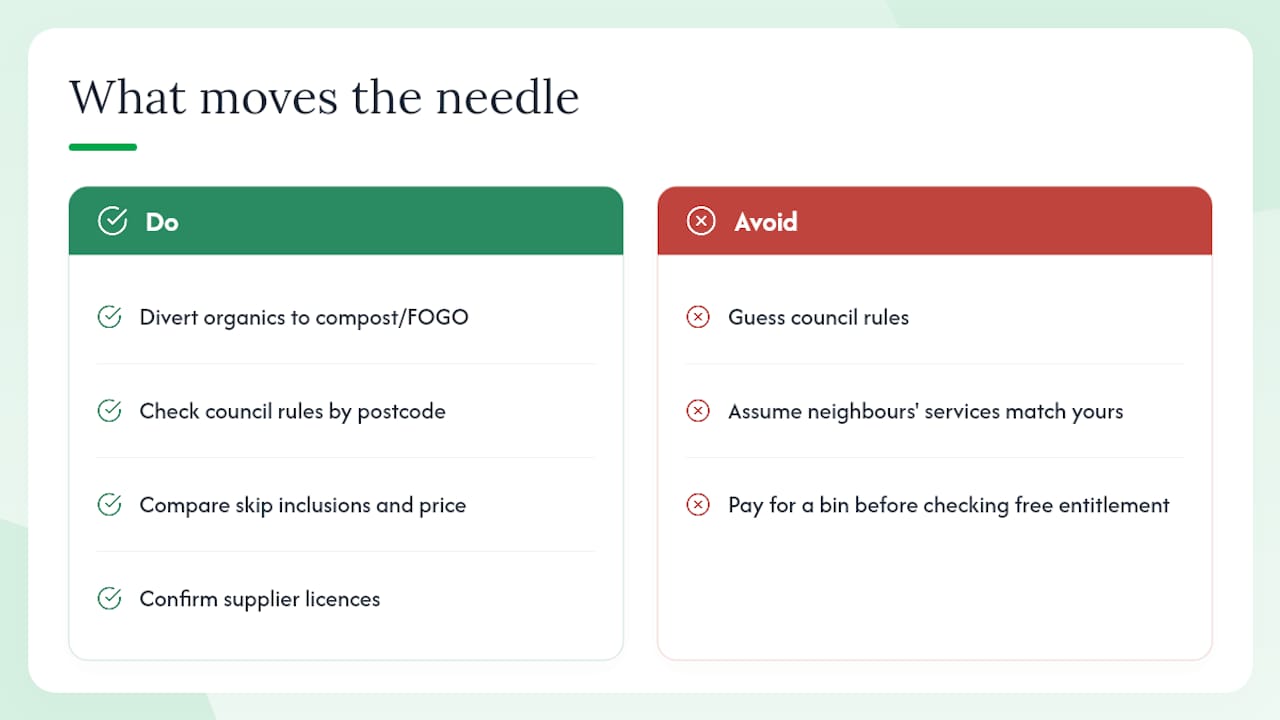
Here’s what gets underestimated: the biggest disposal mistake isn’t putting the wrong thing in the wrong bin occasionally. It’s guessing at council rules instead of checking them. Services and accepted items vary so much between councils that advice which is dead right in one postcode is flatly wrong two suburbs over. That single habit, checking before you assume, prevents more contamination, more rejected loads, and more wasted trips than any amount of careful sorting.
Localskipbinhire built its marketplace model around that same principle: transparent, postcode-matched pricing so you’re not guessing what a skip bin actually costs or what’s included. With over 15 years in the industry, the approach has stayed consistent. Compare what’s included before you book anything, confirm the supplier’s licences, and remember that for a single bulky item, your council’s free entitlement is often still the better option than paying for a bin.
— Brett
Where to Check the Rules Yourself
Council pages change their accepted-item lists more often than most guides do, so it pays to bookmark the primary sources directly:
- ABS Waste Account, Australia for national waste and recycling statistics.
- DCCEEW recycling guidance for federal advice on kerbside recycling.
- Planet Ark’s RecyclingNearYou to find local drop-off points by postcode.
- TechCollect for e-waste recycling under the National Television and Computer Recycling Scheme.
- PaintBack for paint and paint-container drop-off locations.
- Your own council’s bulky waste page, such as the ACT Government’s bulky waste service, for local entitlements and booking steps.
Book the Right Bin Once You Know What You’re Clearing
Council services handle the everyday stuff well. Where they fall short is volume, hazardous exclusions, and timing, and that’s exactly where Localskipbinhire is built to help. Instead of waiting weeks for a bulky collection slot or making three trips to the tip in a hatchback, you compare postcode-matched skip bin suppliers and book a size that actually fits the job, with delivery, pickup, and disposal all folded into one upfront price.
If you’re clearing a garage, a hoarder house clean up, or renovation debris that your council flatly won’t touch, start by browsing bin sizes for your area, such as this Melbourne 4m³ skip bin or a smaller 2m³ heavy waste bin for a single-room clean out. Strata managers coordinating a shared clean out, and homeowners in outer suburbs like Box Hill, get the same transparent, all-inclusive pricing. If upfront cost is a concern, Localskipbinhire also offers pay-later options so the job doesn’t have to wait on your next pay cycle. Punch in your postcode and compare what’s available near you before your next big clean out.
Sources
- Waste Account, Australia, experimental estimates (ABS)
- Tips for recycling at home (DCCEEW)
- Food and organic waste (Your Home / Commonwealth)
- Free bulky waste collection service (ACT Government)
- Reducing waste (Australian Government)
Recommended
← Older Post Newer Post →