

4 Ways to Dispose of a Couch in Australia by Speed, Cost and Condition
Brett Taylor couch disposal australia en
Your couch leaves your home in one of four ways: booked council bulky-item pickup, donation to a charity or reuse group, a drop-off at your local transfer station, or a paid removal or skip bin service. Pick council if you can wait a few weeks, donation if the couch is still in good shape, the tip if you’ve got a trailer and want it gone today, or a paid service if you’re on a deadline or can’t move it yourself. Always check your council’s rules first. Skipping that step is how people end up with an unwanted fine instead of an empty living room.
TL;DR:
- Choose a disposal method based on your urgency, with council pickups taking two to nine weeks, donation if in good condition, and paid services or a transfer station run for immediate removal.
- Always check your local council’s rules and booking procedures first to avoid fines and ensure proper placement, especially for bulky-item pickups or tip visits.
- Preparing your couch by measuring, disassembling, and photographing it can prevent delays, surprise fees, and make the process smoother.
- Transfer station drop-offs require a suitable vehicle, proof of residency, and assistance for heavy lifting, with fees varying by region.
- Regional rules differ widely across Australia, so verify your specific council’s regulations for collection, disposal, and potential fines before you proceed.
Table of Contents
- Quick Shortlist: Choose by Speed, Condition and Cost
- Council Bulky-Item Collections: How Booking, Limits and Reuse Work
- Donation and Reuse: Condition Rules and What to Do if You’re Knocked Back
- Transfer Station Drop-Off: Fees, Vehicle Needs and What to Expect
- Professional Removal and Skip Bin Hire: Pricing and When It’s Worth Paying
- How to Choose the Right Disposal Method: A Practical Checklist
- Preparing Your Couch for Pickup: Measurements, Disassembly and Safety
- Do Couch Disposal Rules Differ Across Australian States and Territories?
- Balancing Speed, Cost and Environmental Responsibility
- Get Your Couch Gone Without the Truck Rental Headache
- Where to Verify Local Rules and Booking Details
- Sources
Quick Shortlist: Choose by Speed, Condition and Cost
Match your timeline and the couch’s condition to the right channel before you do anything else.
- Need it gone today or tomorrow: paid removal or a same-day hauler.
- Can wait one to two weeks: donation or charity pickup, if the couch is in good condition.
- Can wait two to nine weeks: council bulky-item collection, usually free.
- Have a trailer and want to act now: transfer station drop-off.
| Method | Typical cost | Typical wait |
|---|---|---|
| Council bulky pickup | Free | two to nine weeks |
| Donation/charity | Free | Days to 2 weeks |
| Transfer station | moderate price range (tip fee plus vehicle) | Same day |
| Paid removal/skip bin | Quoted upfront; varies by size and access | same day or next-day |
Prices shift by council area and region, so treat these as reference bands rather than fixed quotes. The sections below break down each route in detail, including exactly how to book, what to prepare, and where the legal traps sit.
Council Bulky-Item Collections: How Booking, Limits and Reuse Work
Most Australian councils run a booked bulky-item, or “hard rubbish,” collection that takes furniture including couches. You typically book online through your council’s website, choose an available date, and place the item at an accessible kerbside spot the night before or morning of collection.
The City of Sydney’s bulky-item booking page shows the pattern most councils follow: bookings come with per-collection item limits, and residents in apartments usually arrange pickup through their building manager rather than booking individually.
Statistic Callout: Councils often space free bulky pickups over several weeks, and a missed or unbooked placement frequently remains uncollected on the kerb.
Steps that keep the process smooth:
- Check your specific council’s page for booking windows and item caps.
- Book early. Slots fill fast around school holidays and long weekends.
- Place the couch where trucks can access it, not blocking footpaths or driveways.
- Leave it out only within the timeframe your council specifies.
Collected furniture often gets sorted at transfer stations, with reusable pieces routed to charity shops and the rest broken down for recycling or landfill.
Donation and Reuse: Condition Rules and What to Do if You’re Knocked Back
Charities are choosy, and for good reason. They can only resell or rehome what someone else would actually want in their lounge room. Most reuse organisations run the same basic checks: clean upholstery, no structural damage, no heavy pet odour, and no cigarette smell. Roundabout Canberra’s donation guidelines lay out this kind of condition screen clearly, and it’s typical of what charities around the country expect.
Give yourself the best shot at acceptance:
- Take clear photos from multiple angles before you contact anyone.
- Measure the couch so the charity can confirm it fits their van or truck.
- Vacuum cushions and remove pet hair.
- Disclose any stains or tears upfront rather than letting them find out on pickup day.
Pro Tip: Send photos before you call. Charities that see the couch’s real condition upfront are far less likely to reject it on arrival, which saves you a wasted morning.
If a charity says no, look at local giveaway groups or verified marketplace listings before defaulting to the tip. Someone renovating a share house will often take a couch with minor wear that a charity shop won’t.
Transfer Station Drop-Off: Fees, Vehicle Needs and What to Expect
A transfer station, commonly called the local tip, is the DIY option for anyone with a suitable vehicle and a free afternoon. Furniture is accepted for drop-off, and stations separate recyclable components like timber and metal frames from material headed to landfill, according to Recyclopaedia’s furniture disposal guidance, which also notes that furniture should never go into a household waste bin.
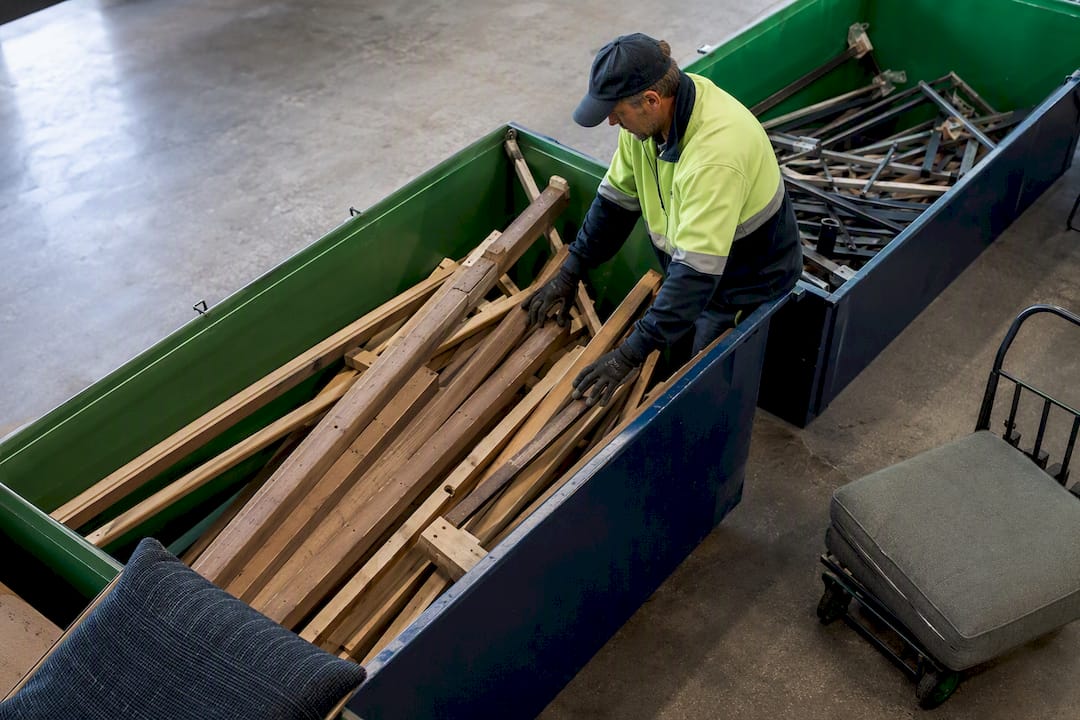
Statistic Callout: Entry fees plus a bulky-item surcharge typically cost an amount varying by council area and load size, generally falling within a moderate price range.
Before you drive there:
- Confirm opening hours. Many stations close earlier on weekends.
- Bring proof of residency; some councils only offer resident pricing to ratepayers.
- Use a trailer or ute. A couch rarely fits in a hatchback.
- Get a second person to help lift. Couches are awkward, not just heavy.
Once you add up trailer hire, fuel, and your own time, the “free” DIY run isn’t always as cheap as it looks on paper.
Professional Removal and Skip Bin Hire: Pricing and When It’s Worth Paying
Paid options split into two broad models. Full-service in-home removal, like the offering from 1300 Rubbish’s couch removal service, sends a crew inside to carry the couch out, which matters if you’re on a third floor with no lift. The other is skip bin hire, where the bin sits at your place and you load it in your own time.
Before paying anyone, though, be honest about whether this is a paid job at all. One couch in good condition is a charity or council-collection job, not a skip job. A skip bin earns its cost when the couch is one item among a bigger clean-out, a garage purge, or a renovation — that’s when clearing everything in one bin beats booking separate services.
What actually moves the price:
- Stairs and access. Three flights add labour time no matter who you book.
- Whether the couch needs disassembling to fit through a doorway.
- Your region. Regional pricing differs from metro pricing.
- Self-load versus labour-included service.
Pro Tip: Ask for a photo-based quote before booking. It’s the fastest way to avoid a surprise “access fee” showing up on the day.
Localskipbinhire matches your postcode to local suppliers and shows all-inclusive pricing upfront, which removes the guesswork from comparing skip bin sizes against a full-service hauler.
How to Choose the Right Disposal Method: A Practical Checklist
Run through these questions before you commit to a method:
- Can you wait? If yes, council pickup is usually free.
- Is the couch still in good shape? If yes, try donation first.
- Do you have a trailer and a spare afternoon? The tip becomes viable.
- Are there stairs, narrow doors, or a lift involved? Lean toward a paid in-home service.
- What’s your budget? Free options cost time; paid options cost money.
If you’re calling a provider, ask directly: Do you include disposal fees in the quote? Do you offer in-home removal, or kerbside pickup only? Where does the couch actually go afterward? Can you quote from a photo instead of guessing on the phone?
Treat any provider who won’t say where your couch ends up, or who suggests dumping it somewhere convenient but unapproved, as a hard pass. That’s the shortcut that turns into your fine, not theirs.
Preparing Your Couch for Pickup: Measurements, Disassembly and Safety
A little prep prevents most delays and every surprise fee.
- Measure the couch and your doorways, hallway turns, and stairwells.
- Photograph the couch from the front, back, and sides for accurate quotes.
- Remove and set aside detachable legs and cushions.
- Disassemble sectionals into separate pieces where possible.
- Wrap cushions in plastic if there’s any concern about pests or moisture.
Pro Tip: If access is genuinely tight, a full-service crew or partial disassembly beats muscling a three-seater around a stairwell landing. Most failed pickups come down to access, not price.
Lift with your legs, not your back, and never attempt a heavy sectional solo down a staircase. Leave the frame carrying to two people minimum, and let the removal crew handle anything that needs to go through a narrow doorway at an angle.
Do Couch Disposal Rules Differ Across Australian States and Territories?
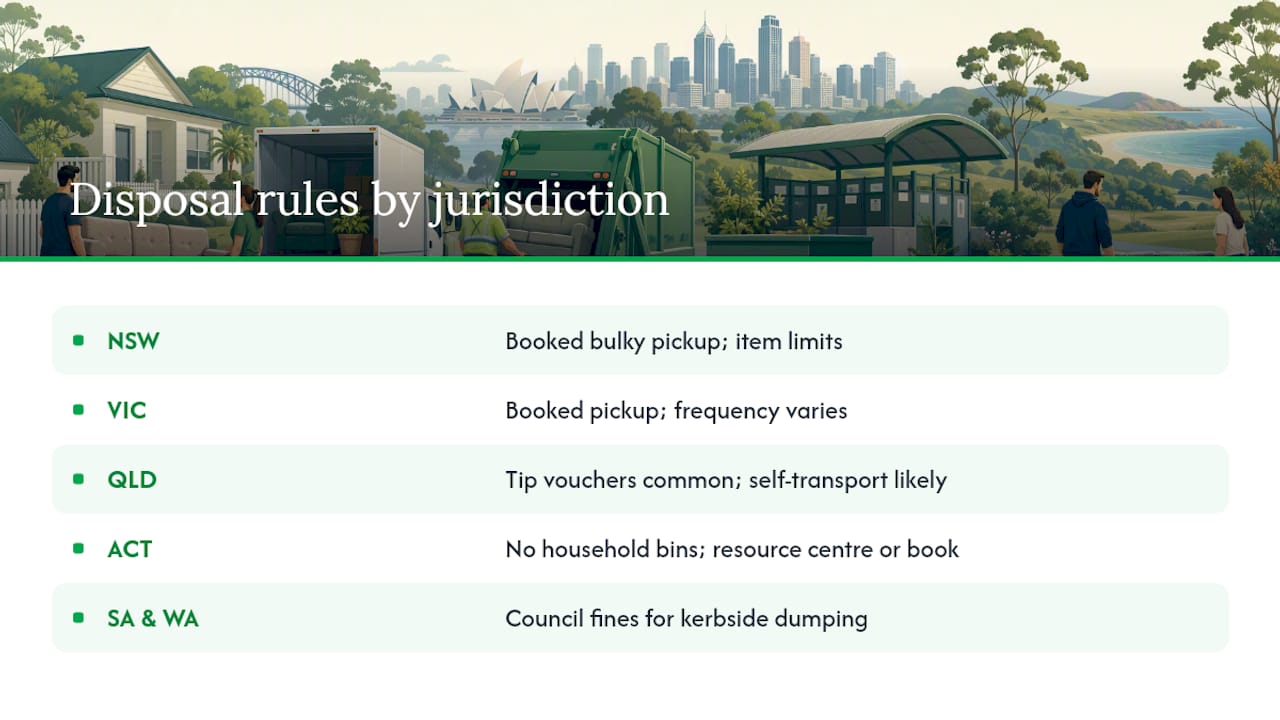
Yes, and the differences matter more than most people expect. Every state and territory sets its own rules for what counts as illegal dumping, how councils schedule bulky-item pickups, and what happens to furniture once it’s collected.
In New South Wales, councils like the City of Sydney run structured booking systems for bulky-item pickup with defined item limits per booking. Victoria’s councils generally follow a similar booked hard-rubbish model, though collection frequency swings widely between inner-city and outer-metro councils. Queensland councils often lean more heavily on tip vouchers issued to ratepayers rather than kerbside collection, meaning a resident may need to transport the couch themselves even for a “free” disposal option.
In the Australian Capital Territory, Recyclopaedia’s guidance makes clear that furniture cannot go into household bins and must be taken to a resource management centre or booked for collection. South Australia and Western Australia both enforce local government waste bylaws with fines for kerbside dumping outside approved collection windows, and those fines vary council to council rather than following a single statewide figure.
The one constant across every jurisdiction: check your specific council’s page before you place a couch on the street. What’s routine in one postcode can be a reportable dumping offence two suburbs over.
Balancing Speed, Cost and Environmental Responsibility
If your couch still has life in it, donation should be your first call, not your last resort. Reuse keeps usable furniture out of landfill and gets it into someone’s home who actually needs it. When your timeline is tight or access is difficult, a paid service earns its cost by handling what DIY can’t. Check your council’s bulky pickup dates or get a quote today if you need it gone sooner.
— Brett
Get Your Couch Gone Without the Truck Rental Headache
Localskipbinhire is the practical middle ground between waiting weeks for council pickup and wrestling a couch onto a trailer yourself. If your timeline is tight, you don’t own a suitable vehicle, or the couch is just one piece of a bigger clean-out, a skip bin handles it alongside everything else you’re clearing.
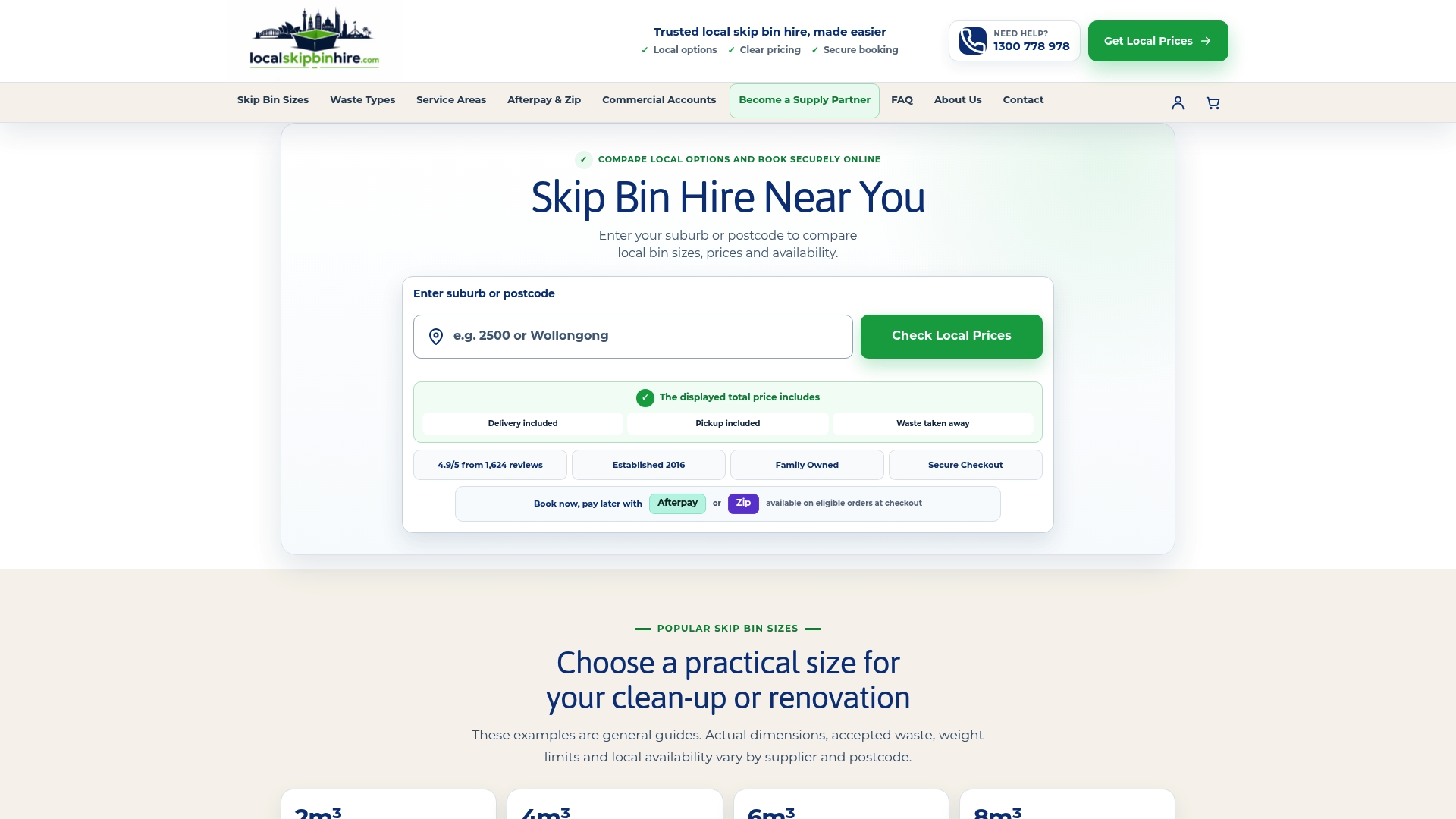
Enter your postcode and Localskipbinhire matches you with local suppliers who show all-inclusive pricing before you book, no on-site surprise fees. Choose a self-load bin if you can handle the lifting, or ask about labour-included options if stairs or access make that a bad idea. A 4m³ skip bin comfortably fits a couch plus a few extra items from the same clean-out, while a 2m³ mini skip bin suits a single sectional piece and not much else. Check your postcode, pick your bin size, and confirm a collection date that actually works with your week.
Where to Verify Local Rules and Booking Details
For rules specific to your address, start with your council’s own page rather than a general guide. The City of Sydney’s bulky-item booking page covers booking steps, accepted item groups, and placement rules. Recyclopaedia’s furniture guidance explains what transfer stations accept and how components get recycled. Both are worth bookmarking before your next clean-out.
Sources
- Free council pick-up for residents - City of Sydney
- Furniture (metal, plastic and wood) - Recyclopaedia
- Couch Removal Services | 1300 Rubbish
Recommended
← Older Post Newer Post →