

Avoid Rejected Pickups: Oil Disposal in Australia and the 0.1 m³ Rule
Brett Taylor en oil disposal australia
A standard skip bin can take drained oil filters, dried oily rags, and empty containers, but not free liquids or large saturated volumes. If your load fits that description, you can book through Local Skip Bin Hire’s postcode-matched suppliers today. If it does not, you need a licensed controlled-waste contractor. Check quantity and condition first, then tell your supplier exactly what you have.
TL;DR:
- Drained oil filters, small dried rags, and cleaned containers are generally accepted in general waste bins if quantities are below approximately 100 kilograms or 0.1 cubic meters.
- Any saturated rags, oil-water mixtures, or large volumes of oil-soaked soil exceed typical bin limits and require licensed controlled-waste handling with proper documentation.
- Proper preparation involves draining all free liquids, drying or absorbing oily materials, and segregating waste types to prevent rejection at the sorting facility.
- When booking, provide accurate weight, volume, waste type, and whether residual liquids exist; preemptively confirm supplier acceptance to avoid rejected loads.
- State guidance varies; it’s crucial to verify local regulations and follow regulator instructions when dealing with borderline or large contaminated volumes.
Table of Contents
- Which Oil-Contaminated Items Skip Bins Actually Accept
- When Oil Waste Becomes “Controlled” Waste
- How to Prepare Oil-Contaminated Materials for Pickup
- What to Tell Your Skip Bin Supplier Before Booking
- Common Mistakes We See When Booking for Oil Waste
- Book the Right Bin Through Local Skip Bin Hire
- Where to Check the Rules Yourself
- Sources
Which Oil-Contaminated Items Skip Bins Actually Accept
The whole question of oil disposal Australia rules comes down to one distinction: is the liquid free-draining, or is it dry and absorbed? Facilities sort every incoming load, and anything that drips is flagged the moment it hits the tip face. That single test decides more outcomes than any other rule in the book.
Drained and crushed oil filters, small quantities of dried oily rags, and empty containers that have been cleaned out are generally workable in a general-purpose skip, though acceptance is always conditional on quantity and the specific supplier’s rules. Push past a modest amount, and you cross into territory that most landfills and transfer stations won’t touch without paperwork.
Here’s how the acceptance logic typically plays out:
- Usually fine: drained oil filters, small dried rags, empty and wiped-out containers.
- Usually refused: saturated rags still weeping oil, oil-water mixtures, un-drained drums, large volumes of oil-soaked soil.
- The gray zone: absorbent material sitting right at the volume limit, where the call depends on the receiving facility.
State guidance commonly points to a rough boundary of 0.1 cubic meters, or about 100 kilograms, of absorbent material as the line between general waste and controlled waste. That figure isn’t uniform law nationwide. Each state EPA and each landfill’s own waste class license sets the final word, so a load accepted in one region can be knocked back in another. Our guide on what can and can’t go in a skip bin covers the broader rules that sit alongside this oil-specific threshold.
When Oil Waste Becomes “Controlled” Waste
Classifying the waste is your job, not the bin supplier’s. Under Queensland’s regulated waste guidance, the generator carries the responsibility for working out whether a load is regulated, based on chemical concentration and how readily contaminants leach out. When you’re not sure, the safer default is to treat it as controlled waste rather than gamble on a rejected pickup.
The approximate cutoff of 0.1 cubic meter or about 100 kilograms is commonly referenced across multiple state guidance documents as the threshold for absorbent material disposed of as general waste; crossing this typically triggers additional procedures.
Once a load is controlled, expect some combination of these:
- Lab analysis or a paint-filter/leachability test to confirm the material won’t shed liquid.
- A licensed controlled-waste carrier, not a standard skip supplier, to handle transport.
- A waste tracking form that follows the load from pickup to final disposal.
- Written facility acceptance, or an immobilisation approval, before the tip will take it.
EPA SA’s guidance on hydrocarbon absorbent materials confirms that small quantities may reach a licensed depot only after passing those immobilisation checks, while larger volumes go straight to licensed treatment. Materials that almost always land in this category include oily sludges, un-drained drums, transformer fluids, and any significant volume of oil-soaked soil from a spill or excavation.
How to Prepare Oil-Contaminated Materials for Pickup
Getting a load accepted usually comes down to preparation, not luck. Follow this sequence before your bin arrives:
- Separate waste types first. Keep oily material away from general household or garden waste so you don’t contaminate the whole bin.
- Drain every free liquid. Tip out drums, filters, and containers completely. Even a small amount of pooled liquid is grounds for rejection.
- Let items dry, or use an approved absorbent. Oil-dampened rags need real drying time or a commercial absorbent, not just a quick wipe.
- Bag and label oily rags separately. A clearly marked bag helps your supplier’s crew make a fast, correct call at the kerb.
- Consolidate and secure empty drums where your supplier allows them, lids on, upright, and clearly empty.
Set up basic containment while you work: bunding or a drip tray under anything that might still weep, sealed containers for absorbent waste, and a spill kit within reach along with gloves and eye protection. Our heavy waste skip bin tips go into more detail on loading dense or awkward material safely.
Pro Tip: Free liquids and dripping items are almost universally knocked back at sorting facilities, even when someone tries to hide them under drier waste. Sorters catch it fast, and a rejected bin often costs you a redelivery fee. Drain first, always.
Stop and call a licensed contractor, or check with your state EPA, the moment you’re dealing with free liquids that won’t drain further or a volume that clearly exceeds the 100-kilogram guideline.
What to Tell Your Skip Bin Supplier Before Booking
The fastest way to avoid a rejected load is giving your supplier the full picture upfront, not at the kerb. Have this ready when you book:
- An estimated volume or weight (cubic meters or kilograms), not just “a few bags.”
- Whether any free liquids remain, even trace amounts.
- The exact waste types involved: filters, rags, soil, containers.
- An SDS or lab report if you already have one on hand.
Then ask your supplier directly:
- Do you accept drained oil filters and dried rags at this quantity?
- If this turns out to be controlled waste, are you a licensed carrier, or will you refer me elsewhere?
- Can you provide a waste tracking form if one’s required?
- What size and type of bin fits this load, heavy waste or general?
- Is there a surcharge for oil-contaminated material, and what’s the total all-in price?
Confirming pickup turnaround and labour options (self-load versus assisted) rounds out the conversation and avoids surprises on the day.
Common Mistakes We See When Booking for Oil Waste
The most frequent caller mistake is underestimating quantity, someone says “a bit of oily rag” when it’s closer to 20 kilograms of saturated absorbent. Postcode-matched suppliers catch this early by asking specific questions before dispatch, which prevents a wasted trip and a rejected bin at the tip.
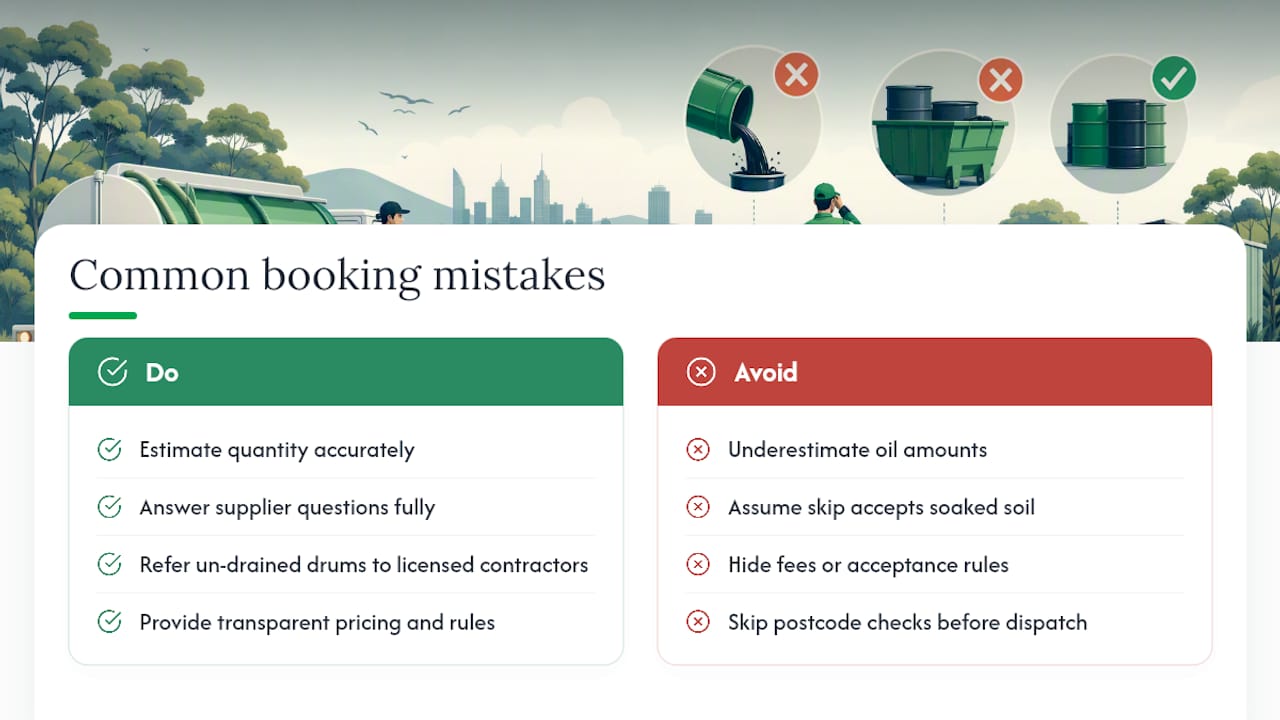
We’ve referred callers with un-drained drums and large oil-soaked soil volumes straight to licensed controlled-waste contractors rather than pretend a general skip could handle it. That’s the honest call, even when it’s not the easy one.
Fifteen-plus years of matching Australian households and trades to local suppliers has taught us that transparent, upfront pricing and clear acceptance rules prevent almost every dispute that reaches us after the fact.
— Brett
Book the Right Bin Through Local Skip Bin Hire
Local Skip Bin Hire is the practical alternative to guessing whether your local tip will take an oily load, sort it out before the truck even arrives. We match you to postcode-based suppliers who know their own facility’s acceptance rules, offer both general and heavy-waste bin sizes, and quote a single all-in price with delivery and pickup included.
Tell us your estimated volume, whether any free liquid remains, and the exact waste types when you book, and we’ll match you to a supplier equipped for it. If your load turns out to need a licensed controlled-waste carrier, we’ll say so rather than take a booking we can’t fulfill properly. For denser or heavier oil-contaminated material, a heavy waste skip bin is often the better fit than a standard bin. Household and small-trade jobs elsewhere on the site, including flexible pay-later options, are just as easy to sort. Ready to check what’s available near you? Start with your postcode at Local Skip Bin Hire and get a quote before you load a single bag.
Where to Check the Rules Yourself
State guidance is worth reading firsthand rather than taking any supplier’s word for it, particularly when a load sits near the 100-kilogram line.
- EPA WA’s controlled-waste referral guidance confirms how the 0.1 m³ threshold gets applied in practice.
- EPA NSW’s waste classification guidelines explain the immobilisation approval pathway for borderline material.
- For hydrocarbon-contaminated soil or sludge beyond what a skip bin can handle, certified hazardous material removal specialists can advise on safe handling.
If a supplier’s instructions ever contradict your state EPA’s published guidance, follow the regulator and keep a record of what you were told.
Sources
- EPA WA – referral/controlled-waste guidance (example document)
- Queensland Government – Regulated waste classification guidance
- EPA SA – Disposal of used hydrocarbon absorbent materials guidance
- EPA NSW – Waste classification and immobilisation guidance
Recommended
← Older Post Newer Post →