

Can You Put Gas Bottles in a Skip Bin? Here's the Answer
Brett Taylor en gas bottles skip bin
No. Never put a pressurized gas bottle in a skip bin, kerbside rubbish bin, or recycling bin. That includes BBQ cylinders, camping bottles, and full-size LPG tanks, whether you think they’re empty or not. A skip full of general waste gets compacted, crushed, or tipped, and any residual gas inside a cylinder can ignite or explode under that pressure.
The safe alternatives are straightforward:
- Supplier take-back or swap programs (ELGAS depots, SWAP’n’GO locations)
- Community Recycling Centres (CRCs) or council hazardous-waste drop-off events
- Licensed hazardous-waste collectors for businesses or bulk quantities
This isn’t just a rulebook technicality. A crushed cylinder in a truck or landfill can injure the waste crew loading it and damage expensive compaction equipment, which is exactly why gas bottles top the “unaccepted items” list for practically every skip provider and council service.
TL;DR:
- Residual pressure in gas bottles can cause explosions during compaction, posing risks to waste crews and damaging equipment.
- Safe disposal options include supplier take-back programs, community recycling centers, licensed hazardous-waste collectors, and retailer swap desks.
- Always confirm the acceptance and transportation procedures with the disposal site before attempting to drop off or transport a gas cylinder.
- For businesses, gas cylinders are classified as dangerous goods, requiring scheduled pickups by licensed operators to avoid legal liabilities.
- Never mix pressurized gas bottles with household waste or skip bin contents, and treat every “empty” cylinder as if it still contains residual gas.
Table of Contents
- Why Gas Bottles Are Hazardous in Skips and Bins
- Accepted Safe Disposal Routes for Gas Bottles
- Preparing a Gas Bottle for Transport or Drop-off
- What Businesses Need to Know About Bulk Gas Bottle Disposal
- How Localskipbinhire Helps With Gas Bottle Disposal
- What the Rules Get Right and Where They Fall Short
- Ready for a Compliant Collection? Here’s How to Book One
- Key Takeaways
- Where to Confirm Local Gas Bottle Disposal Rules
- Sources
Why Gas Bottles Are Hazardous in Skips and Bins
Here’s what most people get wrong: an “empty” gas bottle usually isn’t empty at all. Cylinders retain residual pressure even after the gas supply seems to run out, because a small volume of gas stays trapped inside once the pressure drops below what your appliance needs to draw from it. That leftover gas is enough to cause a serious incident if the cylinder gets crushed or punctured.
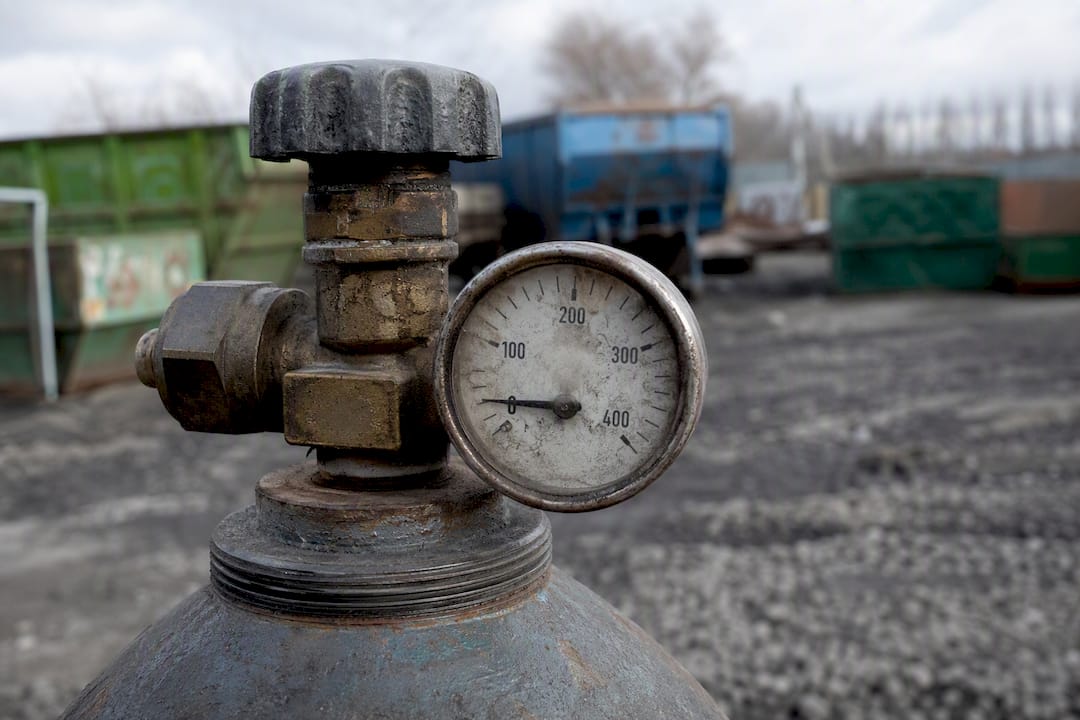
Think about what actually happens to a skip bin’s contents. It gets compacted at the depot, tipped into a truck, or shifted around by machinery at a transfer station. Any of those actions can rupture a cylinder wall. If there’s an ignition source nearby, which is common around machinery and combustion engines, you get a fire or an explosion.
This is precisely why councils use blunt, no-exceptions language on their websites. Guidance from the City of Greater Dandenong simply states cylinders go “not in any bin.” It’s also why gas bottles and pressurized cylinders appear on the standard unaccepted waste lists that most skip bin operators publish. Cylinders fall under dangerous-goods classification in transport and storage law, which is a different regulatory category from ordinary household rubbish.
- Compaction can rupture a cylinder even at “low” residual pressure
- Fires and explosions from mishandled cylinders can damage trucks and injure crews
- Dangerous-goods rules are why depots and skip providers refuse cylinders outright
Accepted Safe Disposal Routes for Gas Bottles
You’ve got several legitimate paths for gas bottle disposal, and which one fits depends on the cylinder’s size, condition, and whether you’re a household or a business.
- Supplier take-back and swap programs. ELGAS runs depot drop-offs and swap options for many common cylinder sizes, and its knowledge hub confirms depots often accept 4kg and 9kg bottles for recycling or exchange. Availability varies by location, so call the depot before you drive out.
- Community Recycling Centres and council hazardous-waste events. Some councils accept smaller cylinders at resource recovery centres for free. The City of Greater Geelong lists bottles up to 9kg as acceptable at certain sites, and many councils also run occasional hazardous-waste collection days worth checking for on your local council’s calendar.
- Licensed hazardous-waste collectors. For larger cylinders, industrial quantities, or business waste streams, a scheduled collection through a licensed operator is the compliant route, particularly when you’re dealing with more than one or two bottles at a time.
- Retailer swap desks. Programs like SWAP’n’GO and hardware retailers such as Bunnings offer in-store gas swap services for small BBQ-size cylinders. These are convenient but limited: they typically only take standard swap-compatible sizes, and not every store location participates.
If you’ve already booked a skip bin for a renovation or clean-out and you find a stray gas bottle in the pile, don’t toss it in with the rest of your waste. Contact your provider directly and ask about arranging a licensed hazardous-item collection instead.
- Call ahead before visiting any depot, CRC, or swap location to confirm size limits
- Keep cylinders separate from your general skip bin waste at all times
- Ask your skip bin provider about licensed collection options for hazardous items
Preparing a Gas Bottle for Transport or Drop-off
Getting turned away at the depot wastes a trip and leaves you back where you started, so a little preparation goes a long way.
Never puncture, crush, or attempt to empty a cylinder yourself. It doesn’t matter how confident you feel that it’s empty. That’s a job for licensed handlers with the right equipment, not a DIY project in your garage.
Before you transport it, close the valve fully and fit the protective cap if one came with the bottle. If the label has worn off or you’re not sure what the cylinder contained, write the contents on a piece of tape and stick it to the body. This helps whoever receives it assess the risk correctly.
- Keep the cylinder upright in your vehicle, secured so it can’t roll or fall
- Keep it away from heat sources, direct sun, and anything that could spark
- Follow whatever loading instructions the depot or collector gives you on arrival
Pro Tip: Call the depot before you leave home and tell them the size, whether it’s full, empty, or somewhere in between, and the condition of the valve. Depots can often tell you on the phone whether they’ll take it, which saves you a wasted trip.
What Businesses Need to Know About Bulk Gas Bottle Disposal
If you’re a business generating gas cylinder waste, the rules get stricter. Cylinders are classified as dangerous goods, and in jurisdictions like Victoria, businesses are legally required to use licensed operators rather than dropping bottles off casually. Regulators like the EPA and WorkSafe set the standards here, and getting it wrong isn’t just a fine risk. It’s a liability issue if someone gets hurt.
- Treat cylinders as dangerous goods from the moment they’re decommissioned, not just at disposal
- Keep records of collection dates, quantities, and the licensed operator used
- Arrange scheduled removal rather than one-off drop-offs once volumes exceed a handful of bottles
How Localskipbinhire Helps With Gas Bottle Disposal
Localskipbinhire matches you with local, independent suppliers by postcode, and that matters here because gas bottle disposal rules and depot availability genuinely differ from one council area to the next. Our team has spent over 15 years helping Australian households and businesses sort out exactly this kind of tricky waste question, with transparent pricing that always includes delivery and pickup.
- If you’ve got a stray cylinder alongside a renovation clean-out, ask us about routing it to a licensed hazardous-item collection rather than the skip.
- If you’re only dealing with one or two small bottles, a supplier swap or CRC drop-off is often faster and free.
More than half of Australian councils now run dedicated hazardous-waste collection events specifically because misplaced cylinders remain a common cause of waste-facility incidents.
What the Rules Get Right and Where They Fall Short
The safety case here is airtight. An “empty” cylinder is never actually empty, and the fire and explosion risks in compaction and transport are real, not theoretical scare tactics. Where I think the conventional advice falls short is in assuming everyone knows where to take a gas bottle once they’ve been told not to bin it. Most guidance stops at “don’t,” and leaves the “then what” vague.
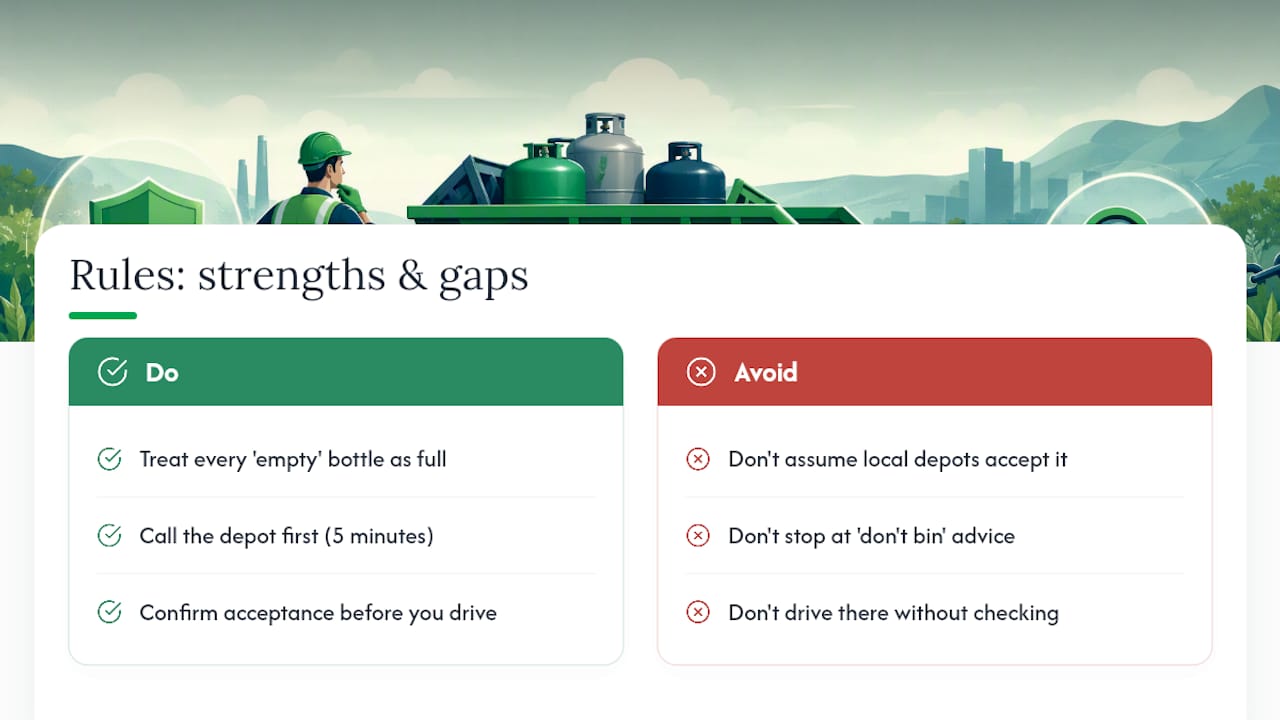
The honest answer is that disposal options vary wildly by postcode. A depot that takes 9kg bottles in one council area might refuse them two suburbs over, and swap desks only work if your cylinder matches their exchange size. That patchiness is the real barrier, not confusion about safety.
My advice: treat every “empty” bottle as if it still has gas in it, because it probably does. Then spend five minutes on the phone confirming acceptance before you drive anywhere. That single call saves more wasted trips than any amount of research into which depot theoretically accepts what.
— Brett
Ready for a Compliant Collection? Here’s How to Book One
If you’ve already got a skip bin booked, or you’re planning one, for a renovation or clean-out, don’t add gas bottles to the pile even if there’s room. Localskipbinhire connects you with local suppliers who can arrange licensed hazardous-item removal alongside your regular waste booking, so you’re not stuck coordinating two separate services.
Before you book, have a few basics ready: how many bottles you’re dealing with, their approximate size (4kg, 9kg, or full LPG tank), and whether they’re full, partially used, or genuinely empty. Photos help if the supplier asks for them. For general renovation or household waste that doesn’t include hazardous items, browse skip bin hire in Box Hill or check postcode-matched pricing on our site to see what’s available near you. If gas bottles are part of the job, mention it when you enquire so we can route you to a supplier equipped to handle them properly.
Key Takeaways
Gas bottles never belong in a skip bin or household waste stream because residual pressure makes them a fire and explosion risk during compaction and transport.
| Point | Details |
|---|---|
| Never bin gas bottles | Skips, kerbside bins, and recycling all refuse pressurized cylinders due to explosion risk. |
| Use supplier swap programs | ELGAS depots and SWAP’n’GO/Bunnings swap desks accept many common BBQ-size cylinders. |
| Check CRCs and council events | Some centres accept bottles up to 9kg for free; hazardous-waste events run seasonally. |
| Businesses need licensed collectors | Cylinders count as dangerous goods, and mishandling creates legal liability. |
| Book smarter with Localskipbinhire | Postcode-matched suppliers can route hazardous items to licensed removal alongside your regular skip booking. |
Where to Confirm Local Gas Bottle Disposal Rules
Rules and acceptance vary by council and supplier, so confirm details before you travel.
- Check ELGAS depot locations and swap options near you.
- Look up your council’s CRC and hazardous-waste event schedule, such as Geelong’s cylinder guidance.
- Businesses should review EPA or WorkSafe guidance for dangerous-goods disposal obligations before arranging removal.
Sources
- Gas bottle disposal recycling — ELGAS knowledge hub
- Recycling gas bottles — RecyclingNearYou
- Unaccepted waste — Jumbo Skip Bins
- Household gas canister and cylinder disposal — City of Greater Geelong
- Gas bottle disposal and recycling — TransNitro
Recommended
- Gas Bottle Disposal in Australia: The Safe, Legal Guide
- www.localskipbinhire.com
- What Can (and Can’t) Go in a Skip Bin in Australia – Local Skip Bin Hire
- www.localskipbinhire.com
What the rest of that load costs
This guide points you to Greater Dandenong and Greater Geelong for local cylinder rules, and those two areas are also a fair look at the bill for everything a skip can legally take. In August 2026, Keysborough, 3173 was quoting from $191 for a 2m³ and $406 for a 4m³, while Breakwater, 3219 in Geelong had the same two sizes at $271 and $465. Across Melbourne a 4m³ typically landed at $543. Book that for the timber, plaster and green waste, keep the cylinders out of it, and confirm the current price for your street from the Melbourne hub.
← Older Post Newer Post →