

Do You Need a Skip Bin Permit in Melbourne?
Brett Taylor en skip bin permit melbourne
Yes, you need a permit to place a skip bin on public or council land in Melbourne, unless the bin sits entirely on private property or within a marked construction parking zone. The fastest next step is confirming your supplier is registered with your local council or arranging the permit through the Service Victoria roadside skip bin form before delivery day.
TL;DR:
- A skip bin placed on public land in Melbourne requires a permit unless it remains fully on private property or within a designated construction zone.
- Application fees vary by council, with processing times typically between 24 hours and two business days, depending on paperwork completeness.
- Placement rules include hours restrictions, minimum clearance distances, reflective markings, flashing lights, and traffic management plans for safety.
- The permit process is usually handled by the supplier, who must hold public liability insurance of at least $20 million and be registered with the relevant council.
- Coordinating with neighbors and confirming the governing council prevents delays, fines, and removals, especially when placing a bin in shared or sensitive areas.
Table of Contents
- What a Skip Bin Permit Melbourne Actually Covers
- How to Apply for a Skip Bin Permit in Melbourne
- Skip Bin Permit Fees and How Long Approval Takes
- Placement Rules and Safety Requirements for Skip Bins
- Who Applies for the Permit and What Insurance Is Needed
- Fines, Refusals, and How to Avoid Them
- How Local Skip Bin Hire Handles Permits for You
- What to Do If Your Permit Application Is Refused
- Permit Rules Differ Across Melbourne’s Councils
- Coordinating With Neighbors and Nearby Businesses
- A Homeowner’s Checklist Before Booking
- Book a Compliant Skip Bin Without the Permit Hassle
- Where to Verify Fees and Rules for Your Suburb
- Sources
What a Skip Bin Permit Melbourne Actually Covers
A skip bin permit in Melbourne, sometimes listed by councils as a “permit to place a bulk rubbish container on council land,” authorizes you to occupy part of a road, footpath, or parking bay with a bin for a set period. The City of Melbourne treats any skip on a public road or council-owned strip as requiring approval, full stop, regardless of how briefly it sits there.
You do not need one if the bin stays fully on your driveway, backyard, or another part of private land with no wheel or edge touching the nature strip or road. Construction sites with an approved parking zone permit often have that arrangement already, though it is worth double-checking with your builder rather than assuming.
Where things get tricky is the address itself. Councils generally expect the bin to sit “in front of the address” it is servicing. If that spot is unsafe or restricted, they will direct you to the nearest workable alternative rather than refusing the job outright:
- Bin fits entirely on your own property: no permit needed
- Bin sits on a nature strip, footpath, or road: permit required
- Site is inside an approved construction parking zone: check with the builder or site manager first
- Preferred spot is a clearway or loading zone: council will suggest a nearby legal alternative
How to Apply for a Skip Bin Permit in Melbourne
Most homeowners never touch a permit application directly, because registered skip bin suppliers handle it as part of the booking. Still, knowing the steps helps you sanity check what your supplier is doing on your behalf.
- Identify which council governs your address, since Melbourne, Port Phillip, and Yarra each run separate systems with different portals and fees.
- Confirm your chosen supplier is a registered operator with that council. Unregistered suppliers cannot lodge a valid application.
- Gather supporting documents: a public liability insurance certificate, site photos, the exact placement address, and a traffic management plan if the bin will sit in a centre-of-road position or a reduced-visibility street.
- Lodge through the council’s own portal or the Service Victoria roadside skip bin form, which forwards your details straight to the right council and can trigger automatic approval when conditions are met.
- Ask the supplier directly whether the permit fee is bundled into your hire quote or billed separately.
Pro Tip: Ask your supplier for the permit reference number once it’s approved. If a council inspector or parking officer questions the bin, having that number on hand saves an awkward conversation.
Skip Bin Permit Fees and How Long Approval Takes
Fees vary by council, but they follow a similar structure: an application fee, a daily permit charge per parking bay, and a higher rate for out-of-hours placements. The City of Melbourne publishes some of the clearest figures in the region.
Processing speed depends on the council and how complete your paperwork is. Yarra City Council notes permits can be issued within 24 hours when documentation is satisfactory, while other councils, including the City of Monash, ask for applications at least two business days before delivery. Build in extra lead time if you need an out-of-hours placement, since those requests typically need manual review rather than automatic approval.
Placement Rules and Safety Requirements for Skip Bins
Every permit condition traces back to one goal: keeping pedestrians, cyclists, and drivers safe around a large object sitting where cars usually park. Councils are consistent on the basics, even when the fine print differs.
- Bins generally must be placed and collected within set local law hours, often weekdays and Saturday mornings, with different windows for early delivery or late pickup.
- Reflective markings are standard, and flashing lights are required in low-visibility conditions or at night, a condition spelled out clearly in Port Phillip’s permit guidelines.
- A minimum clearance, commonly 3 meters, must be kept clear for vehicle access and emergency vehicles.
- Clearways, loading zones, and disabled parking bays are off limits, and councils will redirect you to the nearest compliant spot if your first choice falls in one of these zones.
- A traffic management plan becomes mandatory when the bin sits in a centre-of-road parking area or when loading materials will affect traffic flow.
Safety drives almost every one of these rules, not bureaucracy for its own sake. A skip bin sitting where drivers don’t expect an obstacle is a real hazard, and councils write their conditions around removing that risk.
Who Applies for the Permit and What Insurance Is Needed
Councils expect a registered skip bin supplier, not the homeowner, to lodge the application in nearly every case. That requirement exists because the supplier carries the insurance and equipment liability tied to placing and removing a large bin on public land.
- Public liability insurance is the baseline requirement, and councils commonly ask for a certificate of currency showing $20 million in cover.
- You can verify a supplier’s registration by checking your council’s approved supplier list or simply asking them to send proof before booking.
- If a supplier can’t produce an insurance certificate on request, treat that as a red flag rather than a formality to chase later.
Pro Tip: Homeowners often assume they can apply for the permit themselves to save time. Councils rarely allow this, since the insurance obligation sits with the supplier, so confirm registration status at the booking stage instead of after delivery.
Fines, Refusals, and How to Avoid Them
Placing a skip bin without a permit is not a minor paperwork slip in the eyes of most councils. The City of Melbourne sets minimum fines around $1,000 for unauthorized placement and can order immediate removal at the owner’s cost.
Applications most often get refused or delayed for a handful of predictable reasons:
- The requested location sits in a clearway, loading zone, or too close to an intersection
- Public liability insurance documents are missing, expired, or don’t meet the required cover amount
- The application was lodged too late for the council’s processing window, especially for out-of-hours requests
If your application stalls, the fastest fix is usually moving the bin to private property if that’s an option, or asking your supplier to resubmit with a corrected location or updated paperwork. Contacting the council directly also helps when the holdup is a documentation question rather than a location problem.
How Local Skip Bin Hire Handles Permits for You
Booking through Local Skip Bin Hire matches your postcode to registered local suppliers who already know their council’s permit process inside out. That local matching is the whole point: a supplier working in Yarra every week handles that council’s paperwork far faster than someone unfamiliar with the area.
When you’re comparing quotes, check for a few specific things before booking:
- Whether the permit fee is already included in the quoted price or billed as an extra
- Confirmation the supplier holds current public liability insurance
- Delivery and pickup windows that match your council’s local law hours
- Whether a Melbourne CBD placement needs different documentation than a suburban address
Our guide to skip bin permits across Victoria covers council-by-council quirks in more detail if your suburb isn’t mentioned above.
What to Do If Your Permit Application Is Refused
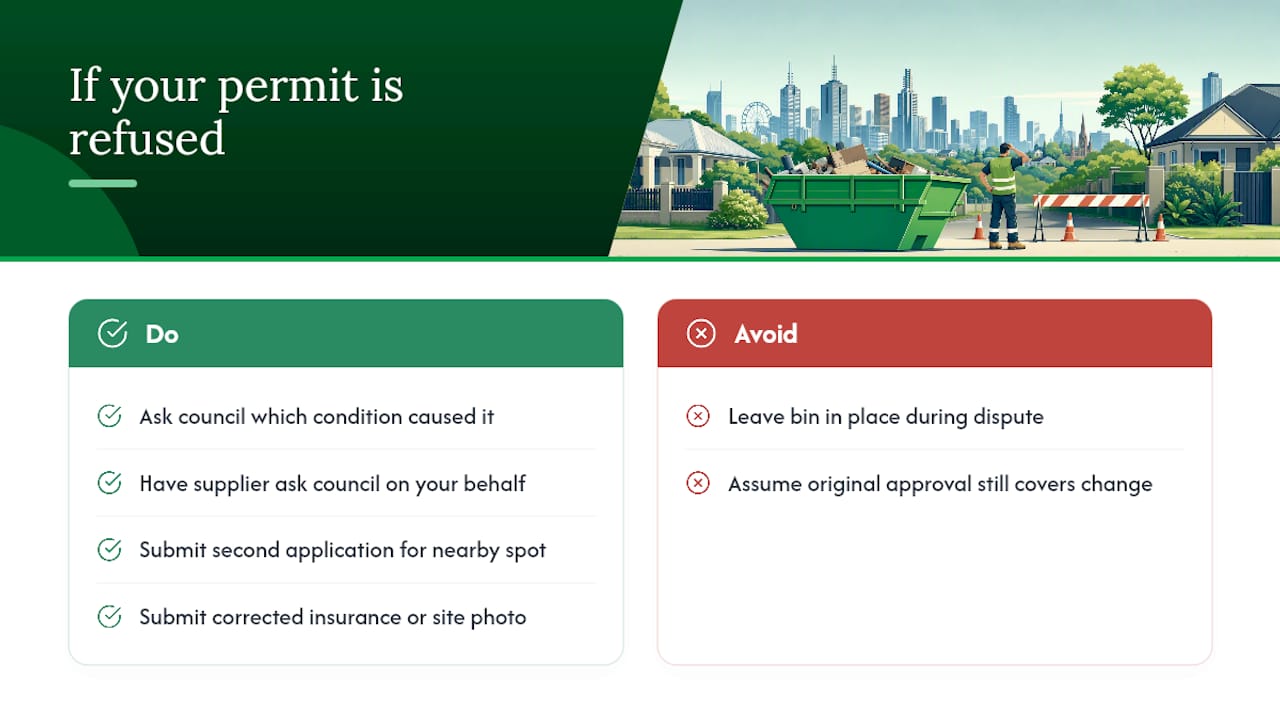
A refusal is rarely the end of the road. Most denials come down to a fixable problem: the requested spot conflicts with a clearway or loading zone, the insurance certificate has lapsed, or the application landed on the council’s desk after the cutoff for that delivery date.
Start by asking the council, or having your supplier ask on your behalf, exactly which condition triggered the refusal. Councils are required to point toward a workable alternative when they reject a location for safety reasons, so a second application for a nearby spot often clears without further trouble. If the issue is paperwork rather than placement, a corrected insurance certificate or an updated site photo usually resolves it within the same processing window.
Amendments work similarly to a fresh application in most council systems. Need to extend the hire period, change the placement date, or shift the bin a few meters down the street? Contact the council (or have your supplier do it) rather than assuming the original approval still covers the change. Some councils treat a date change as a minor administrative update, while others, particularly for centre-of-road placements needing a traffic management plan, require a full resubmission.
The one mistake worth avoiding is leaving the bin in place while a dispute plays out. Unauthorized placement can trigger fines and forced removal even if you have an appeal pending, so if there’s any doubt about your approval status, it’s safer to have the supplier collect the bin and reschedule once the paperwork clears.
Permit Rules Differ Across Melbourne’s Councils
Melbourne is not one jurisdiction when it comes to skip bin rules. It is a patchwork of local government areas, each running its own fee schedule, portal, and processing timeline, and treating them as interchangeable is the single most common mistake renovators make.
The City of Melbourne, covering the CBD and inner suburbs, charges a flat application fee plus a per-bay daily rate and adds a premium for out-of-hours requests. Yarra City Council splits its daily fees between metered and unmetered parking bays, meaning a bin outside a busy Smith Street shopfront can cost differently than one on a quiet residential street a few blocks away. Port Phillip layers on its own safety conditions around reflective markings and clearance distances that go beyond what neighboring councils require.
Processing speed varies just as much as cost. Yarra can turn around an application within 24 hours when the paperwork is clean, while Monash asks for at least two business days’ notice before delivery. If you’re arranging a bin near a council boundary, say, a property that sits close to the line between Melbourne and Yarra, always confirm which council actually governs that stretch of road rather than guessing based on your postal address.
This is exactly why a supplier who works across multiple local government areas is worth more than one confined to a single suburb. They already know which portal to use, which fee schedule applies, and how long each council typically takes to approve a request.
Coordinating With Neighbors and Nearby Businesses
Skip bins rarely sit in a vacuum. A bin placed on a shared nature strip or narrow street affects the neighbor whose driveway it partly blocks, the shopkeeper whose customer parking disappears for a week, or the cyclist who now has three meters less room to pass safely.
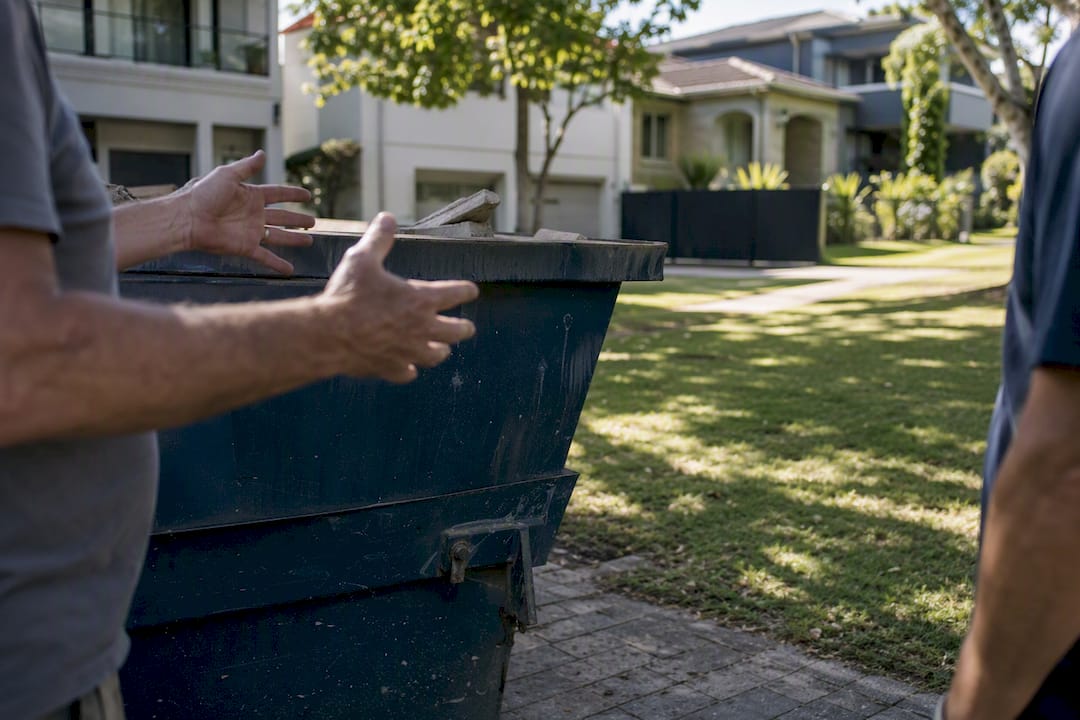
A short conversation before delivery day heads off most complaints before they start. Let immediate neighbors know the bin is coming, roughly how long it will stay, and where exactly it will sit. This matters even more on shared laneways or narrow streets where a skip effectively removes the only nearby parking for several households.
For business strips, check whether your placement affects loading zones or customer parking during trading hours. Councils that require out-of-hours placement in commercial areas do so partly for this reason, since removing a parking bay during business hours creates real friction for shopfronts relying on foot traffic. If a shared driveway or right-of-way is involved, confirm with whoever else uses it that the bin’s dimensions and placement dates won’t block their access.
None of this replaces the permit process, but it does reduce the odds of a neighbor calling the council to complain about an otherwise fully compliant bin. A five-minute heads-up costs nothing and tends to buy a lot of goodwill, especially if the job runs a day or two longer than planned. For larger renovation projects, pairing this kind of neighborly coordination with smart waste disposal budgeting helps keep both costs and disruption in check.
A Homeowner’s Checklist Before Booking
If I were arranging a skip bin tomorrow, I’d start by confirming two things before anything else: which council governs the address, and whether the supplier is registered with that council. Everything else, insurance certificates, placement windows, safety markings, flows from getting those two details right first. Ask upfront whether the permit fee is baked into the quote, and if private property is even remotely workable, take that option over the footpath every time. It sidesteps the whole permit process and the small but real risk of a fine if something about the application goes sideways.
— Brett
Book a Compliant Skip Bin Without the Permit Hassle
Local Skip Bin Hire matches your postcode with registered local suppliers who already know your council’s permit process, so you’re not the one chasing paperwork between quotes from three different companies. That’s the real difference: instead of calling around to figure out who’s actually registered with your council, you compare pre-vetted local suppliers in one place.
When you book through our Melbourne skip bin listings, check the quote for permit inclusion, confirm the supplier’s insurance evidence is current, and match the delivery window to your council’s local law hours before you confirm. If you’d rather browse available sizes and suppliers near you right now, search for skips in your postcode and get a transparent, all-in quote before you commit to a date.
Where to Verify Fees and Rules for Your Suburb
Check the City of Melbourne skip bin page, Service Victoria’s roadside approval form, the ABIS permit listing, or your local council’s website for exact fees.
Sources
- Place skips, bins or containers on the road | City of Melbourne
- Roadside skip bin approval | Service Victoria
- Permit to Place a Bulk Rubbish Container (Skip Bin) on Council Land - City of Melbourne - Victoria
- Skip bin permit - City of Port Phillip
Recommended
← Older Post Newer Post →