

4 Places to Take Old Insulation in Australia and Avoid Refused Loads
Brett Taylor en insulation disposal australia
Old insulation in Australia usually goes to one of four places: your council transfer station, a hard-waste collection (if your council offers it), a skip bin, or a specialist recycler. Before any of that, bag or wrap the material in heavy-duty plastic and put on gloves, safety glasses, and a P2 mask. Skipping that one step is how a simple clean-out turns into a fibre-covered mess.
TL;DR:
- Most Australian transfer stations charge by volume or weight, with higher fees for special waste like fibreglass insulation, and may refuse undeclared or improperly packaged loads.
- Proper preparation, including double-bagging or wrapping insulation in heavy-duty plastic and sealing with duct tape, is essential to prevent fibre escape during disposal.
- Hiring a skip bin reduces logistical issues and ensures proper declaration, with local suppliers matching waste acceptance rules based on postcode to minimize refusal risk.
- Insulation from before the 1990s may contain asbestos, requiring professional removal and testing rather than DIY handling to avoid health hazards.
- Always confirm council-specific rules and acceptances beforehand, as improper disposal can lead to costly delays and refused loads at disposal facilities.
Table of Contents
- Where Can You Take Old Insulation for Disposal in Australia?
- How Do You Prepare Insulation for Safe Removal and Transport?
- What Do Transfer Stations Charge, and Why Do They Refuse Loads?
- When Should You Stop DIY and Call a Professional?
- What Local Skip Bin Hire Has Learned About Booking Insulation Removal
- Why Gatehouse Refusals Are Almost Always Preventable
- Book a Skip Bin That Actually Takes Insulation
- Check These Before You Start
- Sources
Where Can You Take Old Insulation for Disposal in Australia?
Your options depend on how much insulation you’re dealing with and how fast you need it gone. Here’s how the main routes stack up.
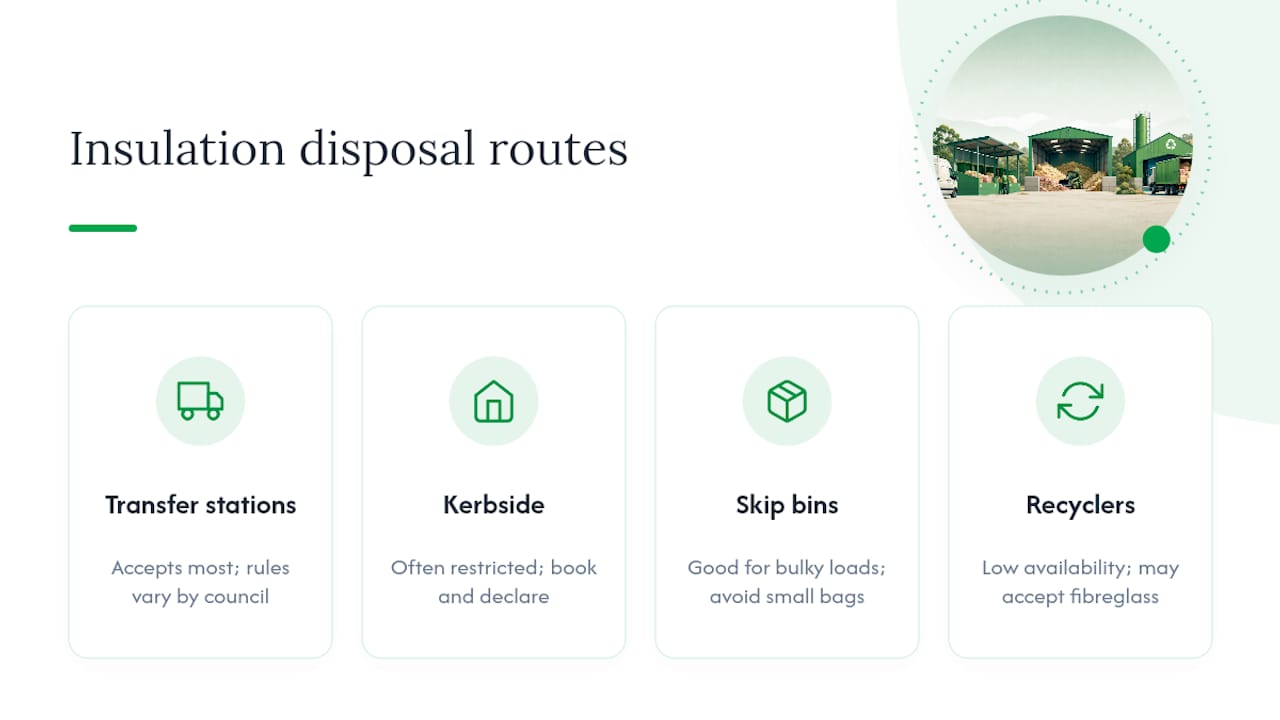
Council transfer stations and landfills are the most common destination. Most sites will take insulation, but expect rules around packaging, and possibly a per-load or per-cubic-meter fee. Monash City Council’s A–Z recycling guide, for example, directs residents to the local recycling and waste center and flags that acceptance rules differ from council to council. That variation is the single biggest trap for homeowners who assume “one council, same as the next.”
Hard-waste kerbside collections work for some residents, but plenty of councils restrict or exclude insulation entirely, or require you to book ahead and declare what’s in the pile. Don’t just dump batts on the verge and hope.
Skip bin hire makes sense once you’re clearing a full roof cavity or wall section, not just a bag or two. A 4m³ or 6m³ bin handles bulky, low-density insulation better than repeated car trips, and you avoid the fuel and time cost of driving back and forth to a transfer station. If you’re already juggling other renovation debris, a renovation waste management plan that groups insulation with your other waste streams saves another trip.
Specialist recyclers exist, but they’re thin on the ground. Recovery facilities for fibreglass and mineral wool remain limited across Australia, so most insulation still ends up in landfill unless you specifically find an authorized recycler nearby before you start ripping material out.
How Do You Prepare Insulation for Safe Removal and Transport?
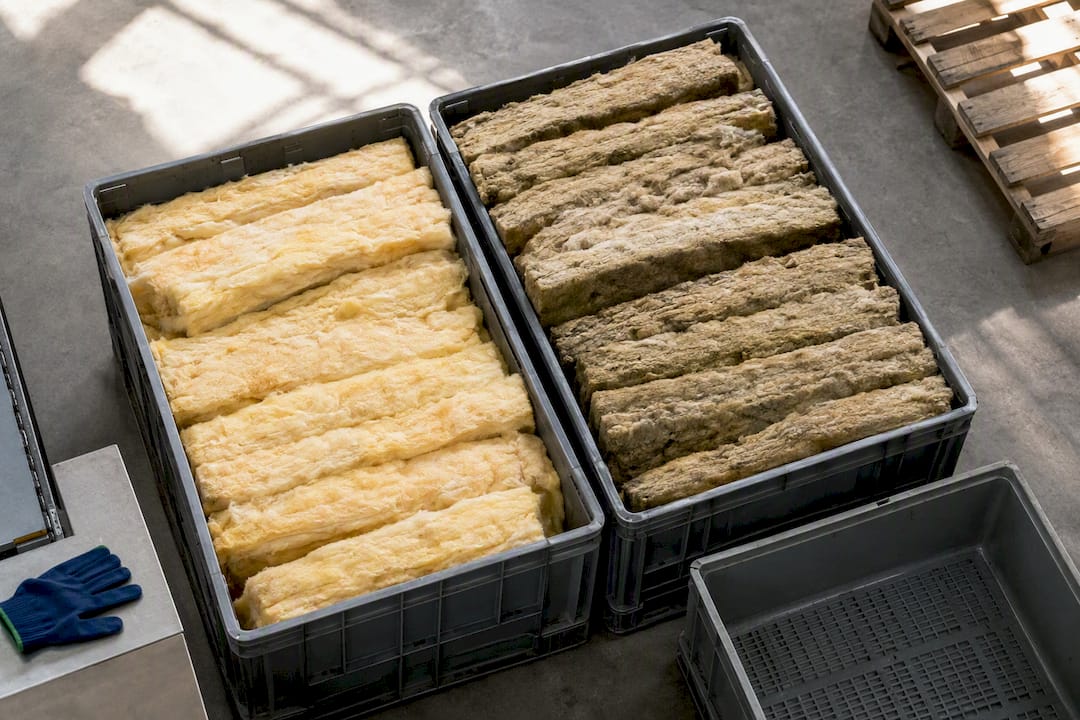
Getting insulation out of a ceiling or wall without turning your lungs and skin into a science experiment takes a bit of discipline. Follow these steps in order:
- Suit up first. Disposable coveralls, gloves, safety glasses, and a P2/N95 mask are the baseline, according to Bunnings’ removal guidance. Switch off your HVAC system so fibres don’t circulate through the ductwork.
- Isolate the work area. Close doors, tape off vents, and keep pets and kids out while you work.
- Roll batts as you remove them rather than stuffing them loose, and bag immediately to cut down on airborne fibres.
- Double-bag small amounts, if your council permits it in general waste, or wrap larger volumes in heavy-duty builders’ plastic. Kimbriki’s insulation rules call for plastic that is suitably thick to prevent fibre escape, sealed with duct tape, in parcels under roughly 20 kilograms. That standard is a good benchmark even if your local transfer station doesn’t publish an exact figure.
- Clean up wet, not dry. A light mist on dusty surfaces before sweeping keeps fibres out of the air, a technique Bunnings recommends alongside careful, methodical bagging.
- Bag your worksuit too. Toss coveralls and gloves straight into the same waste stream once you’re done, rather than shaking them out over the driveway.
Pro Tip: Keep a roll of builders’ plastic and a tape gun in your ute before you start. Trying to source both mid-job, covered in fibreglass dust, is nobody’s idea of a good afternoon.
What Do Transfer Stations Charge, and Why Do They Refuse Loads?
Fees vary by facility, but most charge by cubic metre, by vehicle load, or per parcel, and insulation classified as special waste often carries a higher rate than general mixed waste. Some councils go further: Latrobe City Council requires appointment-only disposal and pre-purchased special bags for some fibreglass insulation, treating it with the same caution as asbestos handling, not because it is asbestos, but because airborne fibres are a genuine irritant risk.
Gatehouse staff will turn away loads that don’t meet basic standards. Common refusal triggers include:
- Loose or unwrapped batts tipped straight into a trailer
- Parcels heavier than the facility’s weight limit (often around 20 kg)
- Insulation mixed in with general rubbish instead of declared separately
- Mechanical tipping attempted where hand-unloading into a designated bin is required
Pre-declaring insulation when you book, whether that’s a transfer station appointment or a skip bin, is what separates a smooth drop-off from a wasted trip.
When Should You Stop DIY and Call a Professional?
Some jobs are beyond a weekend project, no matter how many bin liners you’ve got on hand. Watch for these signals:
- Insulation installed before the 1990s or any material that looks inconsistent with standard fibreglass batts, loose fill, or mineral wool. Older ceiling insulation sometimes contains asbestos, and you cannot identify that by eye.
- Visible degradation, vermin damage, or water staining, which increases both contamination and handling risk.
- Large or awkward roof cavities, complex ceiling structures, or insulation running close to old wiring. A confined space with electrical hazards is not the place to learn on the job.
- Volumes beyond a few bags. If you’re looking at a full roof’s worth, a licensed remover will test, contain, and transport the material correctly, and provide a waste-transfer docket proving where it went.
Before hiring anyone, ask for their licence, current insurance, and confirmation of the facility they’ll be using. A guide to hazardous waste handling is worth a read if you’re unsure whether your situation crosses that line.
What Local Skip Bin Hire Has Learned About Booking Insulation Removal
Accurate waste description matters more than most renovators expect. Tell your supplier upfront that insulation is part of the load, because some suppliers won’t take untreated batts on their trucks at all, and mixed-waste surcharges hit hardest when insulation shows up undeclared. Ask whether pricing is by volume or by weight; insulation is bulky but light, so a volume-based quote is usually kinder to your budget. For larger jobs, a labour-included service that handles loading and clean-up can be worth the extra cost if you’re short on time or hands.
Why Gatehouse Refusals Are Almost Always Preventable
The pattern in this data is consistent: nearly every disposal failure traces back to a homeowner who didn’t check the rules before loading the car or booking the bin. Council A–Z pages exist precisely because acceptance rules aren’t uniform, yet most people still treat “the tip” as a single, generic destination.
The bigger gap is in how casually people treat fibreglass. It’s not asbestos, but airborne glass fibres are a real irritant, and Latrobe’s asbestos-style handling for some insulation is a signal worth taking seriously rather than dismissing as council overcaution.
My take: skip bin hire is underrated here specifically because it removes the guesswork of transfer-station logistics, weight limits, and hand-unloading rules. You declare the waste once, at booking, and someone else deals with the gatehouse. The mistake I’d prioritize fixing first isn’t the PPE or the bagging. It’s calling ahead. A five-minute check against your council’s page or a supplier’s terms prevents almost every refused load this article describes.
— Brett
Book a Skip Bin That Actually Takes Insulation
This service cuts out the guesswork of calling transfer stations one by one to find someone who’ll actually take your insulation. Because bookings are postcode-matched, you get local suppliers who already know the acceptance rules for your area, instead of guessing whether your load will be turned away at the gate.

Pricing is transparent and all-inclusive, so delivery, pickup, and disposal are quoted upfront with no hidden mixed-waste surcharge sprung on you later. That matters most with insulation, since it’s the kind of material that can attract special-waste rates if it isn’t declared properly from the start. Whether you’re clearing a single roof cavity or a full renovation’s worth of batts, compare skip bin sizes to find the right fit, or check options for a Box Hill skip bin and similar local pages to get a quote. Declare the insulation when you book, ask about labour-included loading if you need it, and get your price sorted before the truck arrives.
Check These Before You Start
Confirm acceptance and packaging rules with your own council’s A–Z recycling page first. Whittlesea’s insulation guidance, Kimbriki’s bagging standards, and Bunnings’ removal advice are all solid starting points.
Sources
- Insulation - Kimbriki
- How To Remove Insulation - Bunnings Australia
- Insulation and underlay - Monash City Council
- Asbestos and Fibreglass Insulation Disposal | Latrobe City Council
Recommended
← Older Post Newer Post →