

Skip Bin Hire Duration: What Homeowners and Tradies Need
Brett Taylor en skip bin hire duration
Most skip bin suppliers set a standard hire window of 7 to 14 days, with the delivery date counted as day one. That clock keeps running through weekends and public holidays, so a skip dropped off on a Friday for a “two week” hire is due back before you know it. For a quick weekend cleanup, a 7-day hire usually covers it. For a bathroom reno or a garden overhaul, book closer to the full 14 days.
- Standard hire window: 7 to 14 days, set by the supplier
- Day one = delivery day, not the day you start filling it
- Weekends and public holidays count toward your total
Key Takeaways
Skip bin hire duration typically runs 7 to 14 days from delivery, and matching that window to your project’s actual pace is what prevents extension fees and permit problems.
| Point | Details |
|---|---|
| Standard window | Most suppliers default to a 7 to 14 day hire period starting on delivery day. |
| Day counting | Weekends and public holidays count as hire days, not just business days. |
| Extensions cost more if rushed | Request an extension before your due date to get daily or weekly rates instead of last-minute pricing. |
| Permits cap public placement | Council permits (commonly 7, 14, 21, or 28 days) override operator hire terms on roads and footpaths. |
| Compare before you book | Local Skip Bin Hire shows supplier hire windows, extension fees, and permit handling side by side at Localskipbinhire. |
Table of Contents
- What Is the Standard Skip Bin Hire Duration?
- What Factors Change How Long You Can Keep a Skip Bin?
- What Happens if You Need More Time on Your Skip Bin?
- What Are the Rules for Placing a Skip on Public Land?
- Can You Get a Skip Bin Collected Earlier Than Planned?
- How Are Skip Bin Hire Days Actually Counted?
- How Do You Choose the Right Hire Period When Booking?
- How Do Hire Periods and Extension Fees Work Behind the Scenes?
- A Marketplace Operator’s Take on Skip Bin Timing
- How Local Skip Bin Hire Simplifies Booking the Right Duration
- Frequently Asked Questions
- Sources
What Is the Standard Skip Bin Hire Duration?
Suppliers set their own default hire period and confirm it in your booking agreement, so it pays to check before you assume. Bushbury Skip Hire notes the correct window depends on the hire agreement, permit needs, and where the bin sits, while EZ Skip Hire runs a straightforward 14-day standard hire from delivery.
You will typically see one of these windows quoted at booking:
- 7 days — common for driveway placements and small clean-outs
- 10 to 14 days — the most common default for household and small trade jobs
- Custom or extended terms — arranged upfront for bigger renovations or commercial sites
Whatever window you’re offered, get it in writing before delivery. A supplier’s confirmation email or hire agreement should state the exact start and due-back dates, not just “two weeks.”
What Factors Change How Long You Can Keep a Skip Bin?
Your ideal hire length isn’t a fixed number. It shifts based on a handful of practical variables.
- Project type and pace — a kitchen strip-out fills a skip faster than a slow weekend garden tidy
- Skip size and fill rate — a 2m³ bin for a bathroom reno might fill in two days; a 6m³ bin for the same job could last the full hire
- Council permits — if the bin sits on a road or footpath, your permit length can cap the hire regardless of what the supplier allows
- Site access and scheduling — tight driveways or shared access can delay delivery or pickup, eating into usable days
- Operator availability — busy periods around holidays mean less flexibility for last-minute swaps or extensions
A big demolition job with daily trade deliveries needs a longer window than a single weekend declutter. Match the hire length to how fast waste will actually pile up, not to a round number that sounds safe.
Pro Tip: Schedule your delivery to land the day before your highest-volume waste day, whether that’s demolition day or the day the skip bin arrives before your council clean-up. It cuts down on paid idle days at the front end of the hire.
What Happens if You Need More Time on Your Skip Bin?
Running over your hire window isn’t a disaster, but it does cost money if you don’t plan for it. Most suppliers charge extensions either as a flat daily rate or a discounted weekly rate, and Rent-a-Skip points out that renewing both a council permit and an operator extension at the same time can stack costs fast if you leave it too late.
- Short overrun (2 to 3 days): usually a small daily fee, easy to arrange with a phone call before your due date
- Long overrun (multiple weeks): often cheaper to switch to a weekly extension rate, but may require a new or renewed council permit if the bin sits on public land
Call your supplier before your hire period ends, not after. Requesting an extension in advance almost always gets you a better rate and avoids the awkward conversation about a truck showing up to collect a bin you still need.
What Are the Rules for Placing a Skip on Public Land?
If your skip sits in your driveway or on private property, you generally don’t need council involvement. Put it on a road, verge, or footpath, and a council permit usually becomes mandatory. The supplier or the customer applies, depending on the operator, so confirm this before delivery day.
- Common permit lengths run 7, 14, 21, or 28 days, according to Rent-a-Skip
- A permit is a hard limit. Your supplier can extend the hire agreement, but they cannot legally leave a skip on public land past the permit date without a renewal
Pro Tip: Book the longest sensible permit window from the start. Extending a permit mid-hire often takes longer than getting the initial approval, and a skip parked without a valid permit can bring fines from the council.
Can You Get a Skip Bin Collected Earlier Than Planned?
Yes, most suppliers will collect early if you call ahead, often at no extra charge within your standard hire term. EZ Skip Hire confirms early pickups are common practice, though don’t expect a refund for unused days on a fixed-rate booking.
- Call the depot directly, don’t just email
- Have your booking reference ready
- Confirm the collection window (same day vs. next available slot)
How Are Skip Bin Hire Days Actually Counted?
Delivery day is day one, and weekends and public holidays count toward your total, not just business days. A typical 10-day hire booked for a Monday delivery might look like: Monday delivery, Tuesday through Thursday heavy loading, a few lighter days over the weekend, then collection the following Wednesday. Build in one or two buffer days at the end rather than cutting it exactly to the wire.

How Do You Choose the Right Hire Period When Booking?
Getting this right the first time saves you from calling for an extension halfway through your project.
- Map out your highest-volume waste days before you book
- Choose a skip size that matches your project’s pace, not just its total volume
- Add 1 to 3 buffer days to your estimate
- Confirm permit length upfront if the bin will sit on a road or footpath
- Ask about extension fees before you book, not after you need one
If you’re not sure how long your project will run, it’s worth reading through how to figure out your project timeframe before locking in a hire length. For bigger jobs where the timeline keeps shifting, it’s often smarter to book a shorter initial period and extend once you see real progress, rather than overpaying for a long hire you might not fill.
How Do Hire Periods and Extension Fees Work Behind the Scenes?
Every supplier sets its own standard hire window and extension pricing, which is why quotes vary even for the same size bin in the same suburb. A marketplace like Local Skip Bin Hire surfaces those supplier-set terms directly on each product listing rather than applying one blanket rule across every provider.
Behind those differences sit real operational constraints:
- Vehicle return schedules — trucks need to be back on the road for the next job, which shapes how flexible a supplier can be on pickup timing
- Depot capacity — a full yard means less room to hold onto extended-hire bins
- Permit administration — some suppliers handle council permit paperwork themselves; others leave it to you
When comparing quotes, check for these specific fields: standard hire days, the extension rate (daily or weekly), and who manages the permit. Those three details tell you more about total cost than the headline price alone.
A Marketplace Operator’s Take on Skip Bin Timing
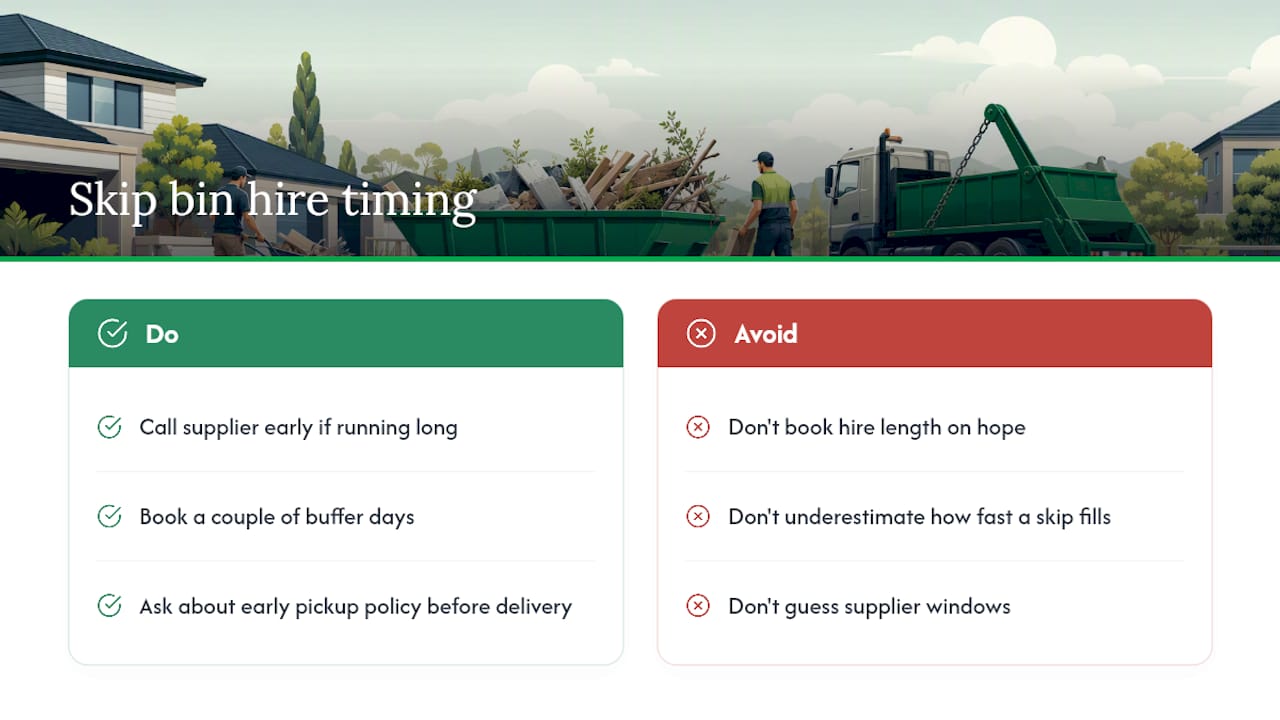
The most common mistake is booking a hire length based on hope rather than pace. Renovators consistently underestimate how fast a skip fills once demolition starts. My advice is simple: call your supplier early if you’re running long, book a couple of buffer days from the start, and always ask about early pickup policy before delivery. Get a quote through Local Skip Bin Hire if you want to compare real supplier windows instead of guessing.
How Local Skip Bin Hire Simplifies Booking the Right Duration
Guessing at hire length and hoping for the best is how extension fees and permit headaches happen. Local Skip Bin Hire lists each supplier’s standard hire window, extension rate, and permit handling right on the product page, so you compare real terms before you commit, not after a surprise invoice.
Because the platform connects you with local suppliers by postcode, the hire windows and pricing you see reflect what’s actually available in your area, not a generic national average. Whether you need a compact 2m³ bin for a weekend clean-out or a larger 4m³ option for a full renovation, delivery, pickup, and standard hire terms are spelled out upfront. If your project might run long, payment options like pay later can also take pressure off a longer booking. Head to the find-a-skip page to compare hire windows and pricing for your postcode and lock in the length that actually fits your job.
Frequently Asked Questions
How long can you keep a skip bin before extra charges apply? Most suppliers include 7 to 14 days in the standard hire price. Anything beyond that window typically triggers a daily or weekly extension fee, so check your specific agreement’s cutoff date.
Does the hire period start on delivery day or when I start filling it? It starts on delivery day, counted as day one, regardless of when you actually begin loading waste. This is the most common source of confusion when people assume the clock starts once the skip is full.
Can I get a skip bin picked up early if I finish sooner than planned? Yes, most suppliers will collect early with a quick phone call, often with no extra fee. Don’t expect a refund for unused days on a standard fixed-rate hire.
What happens if a skip stays on the road past the council permit date? The permit becomes a hard limit that the supplier cannot legally exceed without a renewal, separate from any extension you arrange with the operator directly.
Is a longer hire period always the safer choice? Not necessarily. A longer hire costs more upfront and you risk paying for unused days. It’s usually smarter to book close to your realistic project pace and request a short extension only if needed.
Sources
Recommended
- Skip Bin Hire Melbourne: Sizes, Prices and What Locals Should Know – Local Skip Bin Hire
- Skip Bins for Builders: Running Waste Like a Line Item, Not an Afterth – Local Skip Bin Hire
- Skip Bin Hire Sydney: How to Get the Right Bin at the Right Price – Local Skip Bin Hire
- Figuring Out Your Project Timeframe Before You Rent a Skip Bin – Local Skip Bin Hire
Where shopping the terms actually pays
Asking about extension rates before you book is worth more in some markets than others, and the price spread is the tell. In Canberra one price covered all 30 postcodes we priced in August 2026 — $420 for a 4m³, $560 for a 6m³ — so on price there is little to choose between quotes there. Sydney's 222 postcodes ran the same 4m³ anywhere from $553 to $790, and since each supplier sets its own standard window and extension rate, a spread that wide usually carries differences in the terms as well as in the number.
Size-by-size figures for both markets are on the Canberra and Sydney cost pages; the postcode checker shows what is quoted for your address today.
← Older Post Newer Post →