

Skip Bin Permits: What Australia and the ACT Require
Brett Taylor en skip bin permits act
You need a permit if your skip bin sits on public or council land: the road reserve, a nature strip, or a footpath. You don’t need one if the bin stays entirely on private property, like your driveway or yard. That’s the short answer.
Before you book, get three things sorted:
- Confirm who applies. Many councils require the supplier to hold accreditation and lodge the application; others let the property owner apply directly.
- Gather your documents. You’ll typically need a public liability insurance certificate and a site plan or photo showing exactly where the bin will sit.
- Find your council’s portal. Some Victorian councils process applications through Service Victoria; others run their own online forms.
Keep reading for timelines, fees, and what happens if you skip the paperwork.
Key Takeaways
A skip bin permit is required only when the bin sits on public or council land, and the supplier’s accreditation and insurance are what actually clear an application.
| Point | Details |
|---|---|
| Permit trigger | Required for road reserves, nature strips, and footpaths; not required on private property. |
| Core documents | Public liability insurance (commonly $20 million) and a site plan or photo are standard requirements. |
| Processing time | Most councils process applications within a few working days; Monash requires a minimum notice period for new permits. |
| Fill and content limits | Keep loads below the rim and never place hazardous waste like asbestos or chemicals in a standard skip. |
| Enforcement risk | Unpermitted placement can lead to fines, impoundment, and removal costs billed to the owner. |
Table of Contents
- Who needs a skip bin permit and who applies for it
- When you don’t need a skip bin permit
- What documents does a skip bin permit application need?
- How to apply for a skip bin permit in the ACT
- Where can you place a skip bin, and what safety rules apply?
- What can’t go in a skip bin, and how full can you fill it?
- How much does a skip bin permit cost, and how long does approval take?
- Who’s responsible for the permit: you or your supplier?
- What happens if you don’t have a permit?
- How Local Skip Bin Hire helps you stay compliant
- Skip bin permits: what the rules get right, and where they overcomplicate things
- Sources
Who needs a skip bin permit and who applies for it
Councils generally hold the skip’s owner or supplier responsible for holding accreditation and lodging the application, though some let the customer apply directly if the supplier isn’t already registered. Either way, confirm in writing before delivery day.
You’ll need a permit for a skip placed on:
- The road carriageway or a marked parking bay
- Nature strips and footpaths
- Public laneways
- Activity centers and shared community spaces
Private driveways and land fully inside your property boundary are usually exempt. That single distinction determines almost everything else in this guide.
When you don’t need a skip bin permit
If the skip sits entirely on your own driveway, yard, or private land, most councils won’t require a permit at all. That’s the simplest scenario, and it’s why so many homeowners never deal with council paperwork.
The catch comes with shared or ambiguous spaces. A shared access strip, a bin that partially overhangs a footpath, or any placement that blocks public movement still needs approval, even if most of the skip sits on private ground. When in doubt, call your council before delivery, not after a fine arrives.
What documents does a skip bin permit application need?
Most Victorian and ACT councils ask for a similar document set, though the exact combination varies. Expect to provide:
- An ABN, where the applicant is a registered business
- Supplier registration or accreditation with the local council
- A public liability insurance certificate, commonly set at a $20 million minimum
- A site plan or color photo marking nearby hydrants, stormwater pits, poles, and driveways
- Contact details and the skip’s dimensions
Size and height matter too. City of Monash notes that containers exceeding certain large volume or height thresholds may trigger an Occupy Roadway Permit rather than a standard skip permit, a stricter category with its own conditions.
Pro Tip: Register your chosen supplier with the council in advance if you can. Councils that require supplier accreditation will reject an otherwise complete application if the supplier isn’t already on file, which is the single most common cause of last-minute delays.
How to apply for a skip bin permit in the ACT
The ACT and most Australian councils follow a similar sequence, whether you’re booking through Service Victoria or a local portal:
- Confirm the placement location is council land, not private property.
- Choose a registered supplier, or confirm your existing supplier holds current accreditation.
- Prepare your site plan or photo and your insurance certificate.
- Submit the application through Service Victoria, your local council portal, or your supplier’s own permit process.
- Wait for the approval email before scheduling delivery.
- Book delivery only once the permit is confirmed in writing.
Processing windows vary by council, but City of Monash requires applications at least 2 days before delivery for new permits, and just 1 day for renewals. Across councils generally, expect anywhere from 1 to 10 working days depending on complexity and whether public access will be restricted.
Your approval email will list permitted hours and any special conditions. If your project runs long, contact the council before the permit expires. Extensions are usually easier to arrange than a fresh application after the fact.
Where can you place a skip bin, and what safety rules apply?
Permitted placement hours typically run from around 7am to 7pm on weekdays and 8am to 3pm on Saturdays, though this differs by council and by street classification. Out-of-hours placement almost always needs separate approval.
Beyond timing, safe placement comes down to a short list of non-negotiables:
- Never place a skip on an arterial or high-traffic road
- Keep sightlines, driveways, and stormwater pits clear
- Avoid bus stops and fire hydrants entirely
- Position the bin parallel to the kerb, within a marked parking bay where required
- Fit reflectors, lighting, and clear owner identification on the bin itself
City of Melbourne frames these rules around traffic flow and public safety, not just administration. The road is a shared, finite space, and every rule traces back to keeping it usable for everyone else.
Pro Tip: If you’re loading the skip from the street rather than a driveway, sketch a simple traffic management plan before the day, and never load waste above the bin’s rim. An overloaded skip is unsafe to transport and one of the fastest ways to have a permit revoked mid job.

What can’t go in a skip bin, and how full can you fill it?
Skip bins exist for general waste, not hazardous materials. Commonly banned items include:
- Asbestos and other regulated hazardous waste
- Chemicals and solvents
- Wet or liquid paint
- Food scraps and other putrescible waste, depending on council rules
Most councils also require the load to sit below the bin’s rim, both for safe transport and to avoid material falling onto the road during pickup.
Placing hazardous waste in a standard skip bin isn’t just a compliance issue. It can lead to an outright refusal of service, on-the-spot fines, and disposal costs that dwarf the original hire fee.
If you’re unsure what your project waste qualifies as, check our guide to hazardous waste disposal or the waste categories page before booking.
How much does a skip bin permit cost, and how long does approval take?
Fees vary by council, but a few real examples help set expectations. Wyndham City lists a sample permit fee of $158, while other councils charge separately for the application and for each day the bin occupies a parking bay or road space.
Budget around these figures:
- Standard application fees often vary depending on council
- Additional charges may apply for daily occupation of roads or parking bays
- Higher costs for out-of-hours or extended placements
On timing, expect 1 to 10 working days for standard processing, with some councils, like Monash, requiring a minimum 2 days notice. Out-of-hours requests generally need extra lead time and an additional fee. Most councils allow you to shift the permit date before it starts, but application fees are usually non-refundable once submitted.
Who’s responsible for the permit: you or your supplier?
The bin’s owner or supplier is usually the one legally responsible for holding the permit, not the customer who books it. Still, get this confirmed in writing before delivery, so there’s no confusion about who’s covering what.
Common supplier requirements include:
- Registration or accreditation with the relevant council
- A valid ABN
- A public liability insurance certificate, commonly with a $20 million minimum, as required by councils including Boroondara
Before booking, confirm your supplier is listed as an approved provider with your local council. It’s a five-minute check that saves a delayed delivery.
What happens if you don’t have a permit?
Placing an unpermitted skip on public land carries real consequences, not just a warning letter. Councils can issue infringement fines, impound the bin, and remove it at the owner’s cost if it becomes a hazard or overstays approved conditions.
- Infringement notices for unpermitted placement or breached conditions
- Impoundment and removal, billed back to the owner or supplier
- Refusal of future permits for repeat non-compliance
If you receive an infringement notice, contact the council immediately and provide your permit documentation if you have one. Councils generally review these quickly when evidence of a valid permit exists.
How Local Skip Bin Hire helps you stay compliant
Local Skip Bin Hire matches your postcode to accredited local suppliers, so you’re not left guessing whether a provider actually holds current council registration. Each listing shows the sizes and waste types permitted for that supplier, and delivery windows are coordinated around realistic council approval timeframes rather than guesswork.
With more than 15 years in the industry, the platform builds transparent, all-inclusive pricing into every listing, no hidden delivery or pickup fees tacked on later. Our ACT-specific guide and broader permit and regulation resources walk through location-specific rules in more depth.
- Postcode matching connects you to suppliers already accredited with your council
- Clear size and waste-type filters help you avoid choosing a bin that triggers a bigger permit than you need
- Delivery scheduling lines up with permit approval, not against it
Ready to check availability and accreditation in your area? Compare local skip bin prices and book online before your project date locks in.
Skip bin permits: what the rules get right, and where they overcomplicate things
Council permit systems get one thing exactly right: they’re built around traffic safety, not revenue. The fee structures and paperwork can feel excessive for a two-day skip hire, but the underlying logic, keep sightlines clear, keep hydrants accessible, keep the road usable for everyone else, is sound and worth respecting even where enforcement is inconsistent.
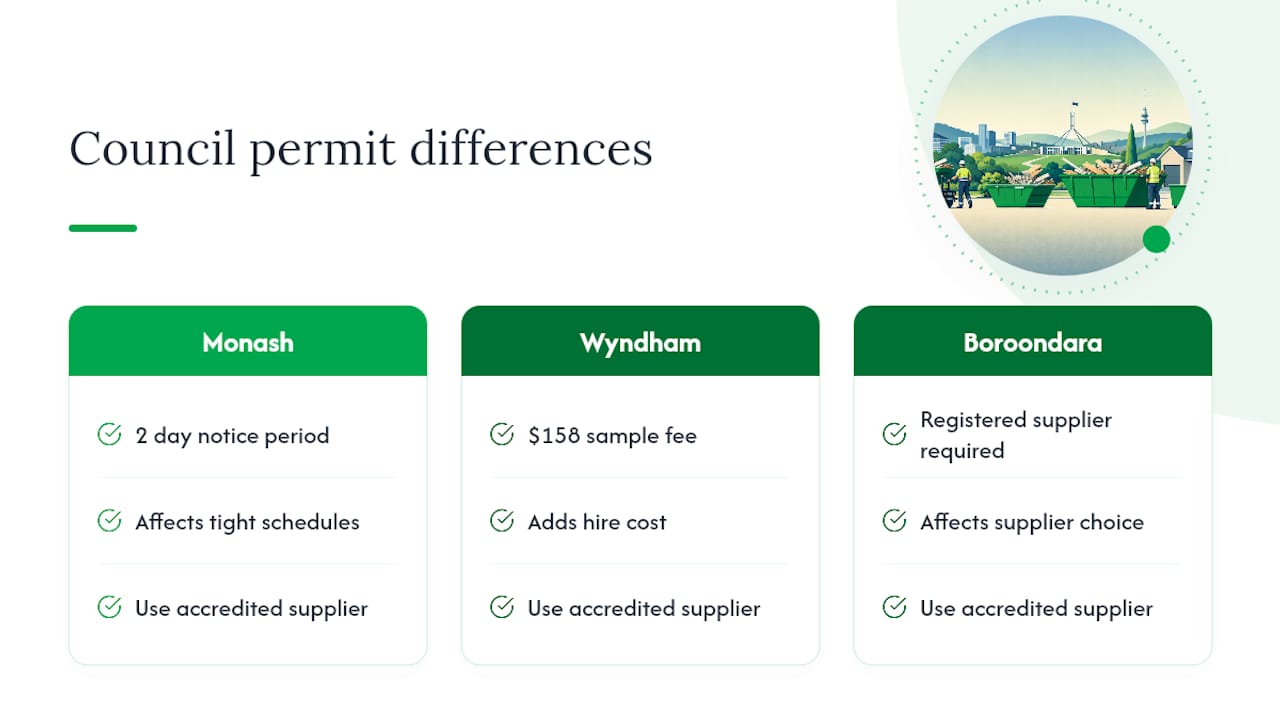
Where the conventional advice falls short is in treating every council as identical. They’re not. Monash’s 2 day notice period, Wyndham’s sample $158 fee, and Boroondara’s registered supplier requirement all differ in ways that matter if you’re planning delivery around a tight renovation schedule. Generic guides that flatten these differences into a single national rule set readers up for a rejected application.
The single highest leverage move for most readers isn’t reading the fine print themselves. It’s choosing a supplier who’s already accredited with their specific council. That one decision resolves the insurance question, the registration question, and most of the timeline uncertainty in one step.
This article is general information, not a substitute for advice from a qualified lawyer. Consult a qualified legal professional about your own circumstances before acting on anything here.
Sources
- Place skips, bins or containers on the road | City of Melbourne
- Skip Bin Permit | City of Monash
- Skip Bin Permit | City of Boroondara
- Get a permit for a trade waste, hopper or skip bin | Wyndham City
Recommended
- A Guide to Permits and Regulations for Skip Bin Placement in Australia – Local Skip Bin Hire
- What Can (and Can’t) Go in a Skip Bin in Australia – Local Skip Bin Hire
- Skip Bin Hire in Northern Territory: What You Need to Know – Local Skip Bin Hire
- Skip Bin Hire Adelaide and Perth: A Guide for the Quieter Coasts – Local Skip Bin Hire
Why the big bin is the harder application
The bins that will not fit on a driveway are also the ones most likely to fall into a council's stricter road-occupancy category, so on a large job the size choice and the permit question are really one decision. It is worth knowing what the top of the ladder costs before you commit to it. Across the postcodes we checked in August 2026, the cheapest 10m³ general-waste quote was:
Soil, bricks and green waste price on their own scale, not this one. Sizes and figures for your own address sit in the price index, and they move month to month, so check yours before you lodge anything.
← Older Post Newer Post →