

What to Do With Demolition Waste on Australian Job Sites
Brett Taylor demolition waste disposal en
On Australian demolition projects, the fastest way to stay lawful and cut disposal costs is straightforward: run a pre-demolition audit, classify the waste, segregate it on-site, and send every load to a licensed receival facility with documentation to prove it. That sequence keeps you clear of the DCCEEW’s national reporting obligations and the NSW EPA’s toolkit requirements alike, whichever state you’re working in.
- Audit the structure before you touch it, and flag anything that needs a licensed hazardous handler.
- Separate concrete, timber, metal, and soils into distinct streams from day one.
- Keep weighbridge receipts and consignment numbers for every load that leaves site.
Nationally, construction and demolition waste made up roughly 40% of total waste generated in 2021 — a scale that makes disposal choices on your project a genuine budget line, not an afterthought.
Key Takeaways
Lawful, cost-effective demolition waste disposal in Australia depends on auditing before demolition, segregating streams on-site, and documenting every load to a licensed facility.
| Point | Details |
|---|---|
| Audit before you demolish | Identify salvage value and hazardous materials before the first wall comes down. |
| Segregate at source | Separating concrete, metal, and timber cuts costs versus paying landfill fees on mixed loads. |
| Track diversion realistically | Expect roughly 64% average diversion nationally, with wide variation by material and state. |
| Document every load | Keep weighbridge receipts, EPL copies, and consignment numbers for every skip that leaves site. |
| Book bins that fit the job | Localskipbinhire matches postcode-specific suppliers with transparent, all-inclusive pricing for each waste stream. |
Table of Contents
- Demolition Waste Disposal by the Numbers: What Australian Projects Are Generating
- Who’s Responsible for Lawful Disposal, and How Do State Rules Differ?
- How Should You Separate and Dispose of Waste On-Site?
- Is Deconstruction Worth It, or Is Demolition Always Cheaper?
- What Should Go in Your Demolition Waste Contract?
- Where Does Skip Bin Hire Fit Into a Compliant Waste Strategy?
- What the Data Actually Tells Contractors to Prioritize
- Frequently Asked Questions
- Sources
Demolition Waste Disposal by the Numbers: What Australian Projects Are Generating
Australia produced 29 million tonnes of construction and demolition waste in 2021–2022, representing around 38% of the country’s total solid waste stream. That volume is why every state now treats C&D waste as a policy priority rather than a footnote in the broader waste strategy.
The national average diversion rate sits at about 64%, but that figure hides enormous variation. Concrete and metal recover at far higher rates than mixed demolition debris or plasterboard, and jurisdiction matters just as much as material type.
Landfill levies are the lever behind most of that variation. Where levies are high, diverting waste to recycling becomes cheaper than dumping it, which is exactly the outcome state governments are chasing. But steep levies without accessible recycling infrastructure can also push some operators toward illegal dumping, a risk regulators are watching closely as levy rates climb.
- Concrete and brick: typically the highest-recovery stream, often processed into road base.
- Timber: recovery varies widely depending on contamination and paint/treatment.
- Plasterboard and mixed debris: consistently the hardest streams to divert from landfill.
Who’s Responsible for Lawful Disposal, and How Do State Rules Differ?
Responsibility doesn’t stop once a skip leaves your site. The NSW EPA’s management toolkit makes clear that both the waste producer and the transporter can be found guilty of an offence if material ends up at a facility that isn’t lawfully permitted to receive it. Ignorance of where a subcontractor’s truck actually went is not a defense.
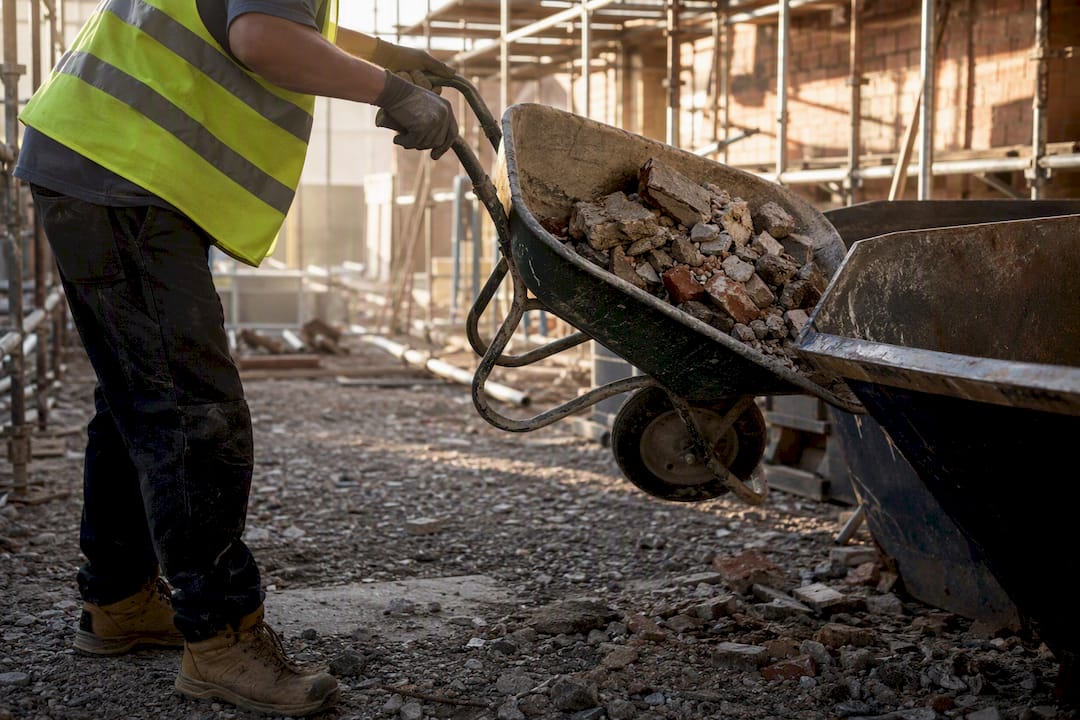
Because federal policy on C&D waste is largely voluntary, the real rules live at state level, and they vary enough to trip up contractors who assume one jurisdiction’s process applies everywhere. Western Australia, for instance, runs its own targets and programs like Roads to Reuse to lift C&D material recovery toward 80%, a different framework entirely from NSW’s licensing and tracking regime.
Before you break ground, confirm these four items:
- Waste classification has been done and documented for each material stream.
- The receival facility holds a current Environmental Protection Licence (EPL) for the waste type you’re sending.
- Consignment numbers or WasteLocate records are generated for any tracked waste category.
- Transport records match what actually left the site, not just what was planned.
Build these into your waste management plan and your head contract, not just your site induction. A WMP should name the disposal method for each stream, the receiving facility, and who holds evidence.
- Weighbridge receipts for every load.
- A copy of the receival site’s EPL.
- Consignment or tracking numbers where waste type requires them.
Pro Tip: Ask your skip bin supplier to provide receival dockets automatically rather than chasing them after the fact. It’s far easier to build a compliance file in real time than to reconstruct one when an auditor calls.
How Should You Separate and Dispose of Waste On-Site?
Segregation is the single biggest lever for both cost and compliance, and it starts before the first skip arrives. Concrete and brick, timber, metal, inert fill, and soils each have different recycling pathways and different penalties for cross-contamination.
Mixed loads almost always cost more. Separating concrete, steel, and inert fill at source often reduces total disposal spend and can even generate revenue through recycled aggregate or metal rebates, while a mixed skip typically triggers full landfill gate fees on the entire load.
- Concrete, brick, and rubble go to inert recycling facilities, often at a lower rate than general waste.
- Timber gets sorted for reuse or mulching, but treated or painted timber may need separate handling.
- Metal offcuts and reinforcing steel are almost always worth separating for scrap value.
- Asbestos and other hazardous materials require a licensed hazardous handler, never a general skip.
- Soils and inert fill may need testing before they can go anywhere but a controlled landfill.
Sizing your skips correctly matters more than most site managers expect. An underestimated bin means multiple pickups and mixed loads when contractors get impatient and toss whatever’s on hand into whatever bin is open. Getting heavy waste loading right from the start avoids overloading fees and the weight surcharges that catch out first-time demolition clients.
Pro Tip: Pre-quantify your waste streams during the audit stage, not once skips are on-site. A rough tonnage estimate per material lets you book the right bin sizes upfront instead of paying for extra swaps.
Is Deconstruction Worth It, or Is Demolition Always Cheaper?
Mechanical demolition is faster and usually cheaper upfront. Selective or full deconstruction takes longer and costs more in labor, but it recovers materials that mechanical demolition simply crushes or discards. The trade-off comes down to salvage value and project timeline, not a universal rule.
Design-stage decisions matter more than most contractors assume. Research reviewing C&D waste minimization strategies consistently finds that interventions made during design offer the largest opportunities to cut waste, ahead of anything done during the demolition phase itself.
Transitioning toward design for disassembly early in project planning can meaningfully lower long-term disposal costs and environmental footprint compared to retrofitting waste strategy after the fact, according to industry analysis on circular building practices.
Materials that most often justify the extra deconstruction cost:
- Structural steel and reclaimed hardwood beams.
- Heritage brick and dressed stone.
- Fixtures, fittings, and architectural salvage with resale value.
A pre-demolition audit is what tells you whether salvage value covers the extra labor. Skip that step and you’re guessing.
What Should Go in Your Demolition Waste Contract?
Your contract is where compliance either gets locked in or quietly falls apart. Specify the waste management plan as a deliverable, not a suggestion, and tie payment milestones to evidence of lawful disposal rather than just completed work.
- Require WMP compliance as a contract condition, reviewed before work starts.
- Withhold final payment until receival documentation is submitted for every load.
- Mandate due diligence checks on both the transporter’s license and the receival site’s EPL.
Documents to hold on file for every milestone:
- Weighbridge receipts matching the waste type and tonnage claimed.
- A current EPL copy for each receival facility used.
- Waste consignment numbers for tracked categories.
GPS tracking or WasteLocate records are worth mandating on any project where subcontractors run their own trucks. Failing to keep a clear audit trail can trigger non-compliance penalties even when the waste genuinely ended up at a licensed facility, because regulators in states like NSW apply strict records tests regardless of the actual outcome.
Where Does Skip Bin Hire Fit Into a Compliant Waste Strategy?
Sourcing the right bin is the easiest part of this whole process to get wrong, and the easiest to get right with the right supplier. Localskipbinhire has spent over 15 years matching Australian projects with independent local suppliers by postcode, which means you get bins sized and priced for your specific site rather than a generic national rate.
Every booking comes with transparent, all-inclusive pricing covering delivery, pickup, and removal, so there’s no surprise weight surcharge buried in the fine print; learn more about smart construction waste disposal in Melbourne to optimize your project costs. That matters when you’re trying to build a clean compliance file: knowing your costs upfront lets you budget properly for separate streams instead of defaulting to one mixed skip because it looked cheaper on paper.
- Choose bin types matched to your waste streams (concrete, mixed demolition, green waste) rather than one general-purpose skip.
- Ask your local supplier for receival evidence at booking so your documentation trail starts on day one.
- Estimate volumes during your pre-demolition audit so you book the right size the first time.
Pro Tip: If your project spans multiple waste categories, book separate bins for concrete and mixed debris rather than one large bin. It costs less overall once you factor in landfill gate fees on contaminated loads.
Ready to line up bins for your next demolition or strip-out? Compare local skip bin prices by postcode and get a supplier matched to your site before the first wall comes down.
What the Data Actually Tells Contractors to Prioritize
Most guidance on demolition waste treats every material stream as equally urgent, and that’s where the conventional advice falls short. The data doesn’t support that. Concrete and metal already recover well because scrap value drives the behavior anyway. The real gap sits in plasterboard, mixed debris, and anything that gets bundled into a single skip out of convenience.
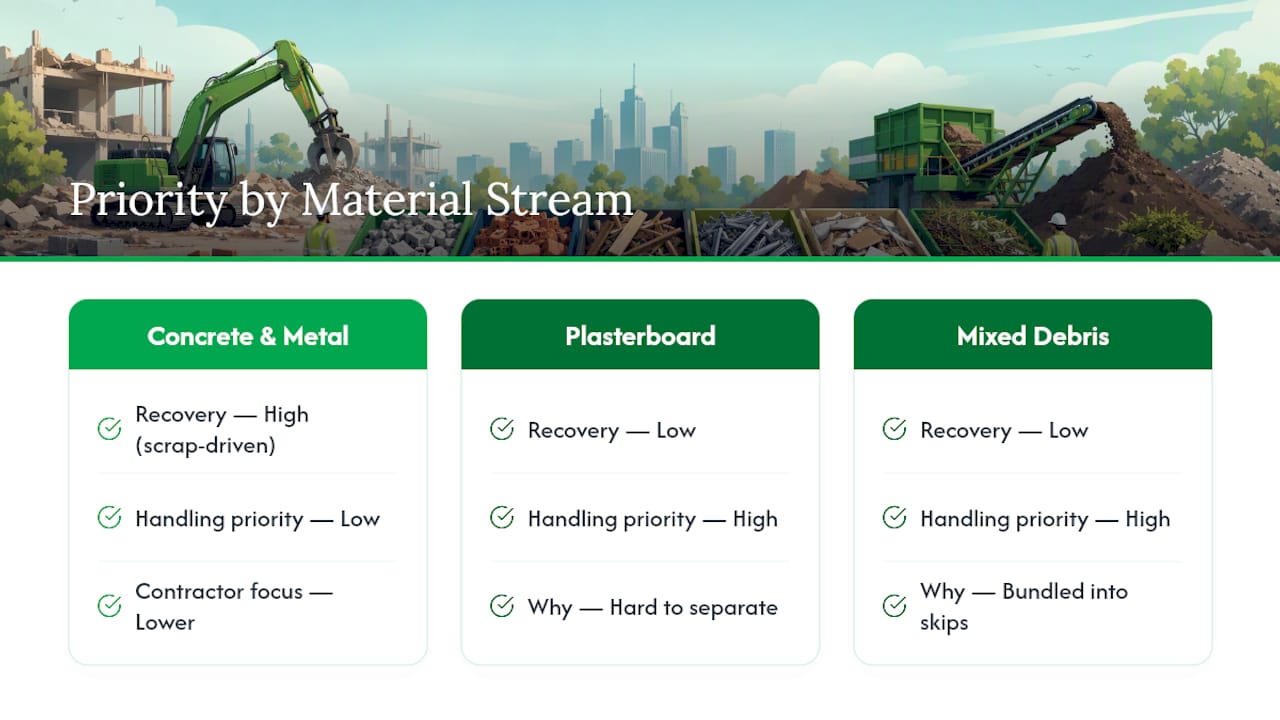
That’s where a pre-demolition audit earns its cost. It’s not a compliance checkbox, it’s the tool that tells you which materials are worth the extra handling and which aren’t.
The other place conventional advice undersells the opportunity is timing. Everyone focuses on what happens once demolition starts, but the research on design-stage interventions is clear that decisions made months earlier, at the design and procurement stage, shape most of the outcome. If you’re a developer working on projects with any renovation-to-demolition pipeline, that’s where the leverage actually sits, not in which skip bin you book in week three.
Frequently Asked Questions
What is the first step in disposing of demolition waste legally in Australia?
Start with a pre-demolition audit to classify materials and identify hazardous substances like asbestos. This determines your waste streams and which facilities can legally receive each one.
How much construction and demolition waste does Australia divert from landfill?
The national average sits at around 64%, though rates vary significantly depending on material type and which state the project is in.
Do I need documentation to prove my demolition waste was disposed of lawfully?
Yes. Weighbridge receipts, a copy of the receival facility’s EPL, and consignment numbers where required are the standard evidence base recommended by the NSW EPA toolkit.
Can I put demolition waste in a general skip bin?
Mixed general skips work for smaller jobs, but larger demolition projects usually cost less overall when concrete, metal, and timber are separated into dedicated bins rather than one mixed load.
What happens if my waste ends up at an unlicensed facility?
Both the waste producer and the transporter can be found liable under NSW EPA rules, even if you weren’t aware of where the load was taken. Vetting your transporter and receival site in advance is essential.
Is deconstruction more expensive than standard demolition?
Usually, yes, in upfront labor costs. But salvage value from materials like structural steel or heritage brick can offset that difference, particularly on projects with a strong pre-demolition audit.
How do landfill levies affect my project budget?
Higher levies make recycling and diversion cheaper than dumping, which is deliberate state policy. Budget for levy costs early since they vary significantly by state and material type.
Should I book separate skip bins for different waste types?
Yes, particularly for concrete versus mixed demolition debris. Contaminated mixed loads typically trigger full landfill gate fees, while separated concrete often processes at a lower rate.
What size skip bin do I need for a small demolition job?
It depends on the structure size and material mix, but a mid-size bin around 4 cubic meters often suits smaller strip-outs. Booking the right size upfront avoids costly extra pickups.
Does every state in Australia have the same demolition waste rules?
No. Federal policy is largely voluntary, so states set their own targets and tracking requirements. Western Australia runs different recovery targets than NSW, for example.
What materials are worth separating for resale or rebate value?
Metal offcuts and reinforcing steel almost always justify separate handling for scrap value. Concrete and brick often qualify for lower-cost inert recycling rather than landfill fees.
How do I handle asbestos found during a demolition project?
Asbestos requires a licensed hazardous materials handler, never a general skip bin. Specialist guidance can help connect you with the right contractor for safe removal.
Sources
- Construction and demolition waste status report - management of construction and demolition waste in Australia
- Construction and demolition waste: A management toolkit (NSW EPA)
- Investigation of C&D waste generation (2024 analysis)
- Investigation of waste diversion rates in the construction and demolition sector in Australia
- Construction and demolition recycling (WA Waste Authority)
Recommended
- Renovation Waste Management: The Playbook That Saves Real Money – Local Skip Bin Hire
- Construction Waste Management Plan for Australian Contractors
- Heavy Waste Skip Bin Hire in Australia: 2026 Guide – Local Skip Bin Hire
- The Environmental Impact of Improper Waste Disposal and How to Avoid I – Local Skip Bin Hire
What the bins cost when you do split the streams
Separating streams only beats one mixed skip if you know what each bin costs. These are general-waste from-prices checked in August 2026 — the baseline for a mixed-debris bin, not a heavy-waste rate — in the sizes strip-outs order most.
In Sydney a 6m³ starts at $651, an 8m³ at $941 and a 10m³ at $1,107. Brisbane runs $637, $844 and $1,103 across the same three; Perth $646, $828 and $1,016. Concrete, brick and soils are quoted as their own waste type and usually held to a smaller bin on weight, so price that bin separately rather than assuming the 10m³ rate carries it.
City ladders: Sydney, Brisbane, Perth; the price index covers the rest. Levies and gate fees move these numbers, so confirm at booking rather than carrying one into a tender.
← Older Post Newer Post →