

Cubic Metre Explained: Visualize and Calculate m3
Brett Taylor cubic metre explained en
A cubic metre (m3) is the volume of a cube whose sides are each one metre long. That single measurement is the SI unit of volume and the standard reference point for everything from shipping containers to skip bins. Two equivalences you will use constantly: 1 m3 equals exactly 1,000 litres and approximately 35.3 cubic feet.
Here is what that means in practice:
- One cubic metre holds the same volume as 1,000 one-litre water bottles stacked together.
- A standard front-load washing machine drum holds about 0.06–0.08 m3, so it takes roughly 13–17 of them to fill a single cubic metre.
- Skip bin hire, furniture removals, and storage unit quotes almost always use m3 as the measuring stick, so getting comfortable with the unit saves you from booking the wrong size.
Key Takeaways
A cubic metre equals exactly 1,000 litres, and the formula V = length × width × height (all in metres) gives you every volume figure you need for moving, storage, or skip bin hire.
| Point | Details |
|---|---|
| Core definition | 1 m3 is the volume of a 1 m × 1 m × 1 m cube, equal to exactly 1,000 litres. |
| Calculation formula | V = length × width × height; convert all dimensions to metres before multiplying. |
| Packing buffer | Add 10–20% to your total estimate to account for gaps and irregular shapes. |
| Volume vs. weight | Always check a bin’s weight limit separately; dense materials hit weight caps before volume caps. |
| Localskipbinhire | Match your m3 estimate to a postcode-specific skip size and book online with all-inclusive pricing. |
Table of Contents
- What does a cubic metre mean, and where does the unit come from?
- How to calculate cubic metres in three steps
- Common cubic metre conversions at a glance
- What does 1 m3 actually look like?
- How to measure accurately and avoid common mistakes
- Skip bin sizes and what they hold
- Why getting your m3 right actually matters
- Book a skip bin matched to your m3 estimate
- Sources
What does a cubic metre mean, and where does the unit come from?
The cubic metre is the official SI (International System of Units) unit of volume. Its symbol is m3, sometimes written m³ or m^3 in plain text. You may also see it called a kilolitre (kL) in water-industry contexts, since 1 m3 equals exactly 1 kL. The American English spelling is “cubic meter,” but both spellings refer to the same unit.
A few things worth knowing about the symbol and related terms:
- The litre (symbol L, preferred by NIST) is a special SI name for the cubic decimetre (dm3), so the litre-to-cubic-metre relationship is exact: 1,000 L = 1 m3.
- “Stère” is an older forestry term for 1 m3 of stacked wood, rarely used outside that context.
- In everyday speech, “cubic meter” and “cubic metre” are interchangeable; only the spelling differs.
Stat to remember: One cubic metre of pure water at 3.983 °C has a mass of exactly 1,000 kg (one metric tonne). That figure is why weight limits on skip bins matter so much when you are disposing of soil, concrete, or sand.
How to calculate cubic metres in three steps
The formula is straightforward: V = length × width × height, with all three measurements in metres. The tricky part is keeping units consistent before you multiply.
Step-by-step:
- Measure length, width, and height in metres (or convert to metres first).
- Multiply the three numbers together.
- The result is your volume in m3.
Worked examples:
- Small moving box (60 cm × 40 cm × 40 cm): Convert to metres first: 0.6 × 0.4 × 0.4 = 0.096 cubic metres, or about 96 litres.
- Fridge (70 cm × 75 cm × 170 cm): 0.7 × 0.75 × 1.7 = about 0.89 cubic metres for planning purposes.
- Spare bedroom (3 m × 3.5 m × 2.4 m): 3 × 3.5 × 2.4 equals approximately 25 cubic metres of air space. The furniture inside that room typically occupies a volume on the order of a few cubic metres once packed.
Quick unit shortcut for centimetres: Multiply all three cm dimensions together, then divide by 1,000,000 to get m3. Or divide by 1,000 to get litres directly. For the box above: 60 × 40 × 40 = 96,000 cm3 ÷ 1,000,000 = 0.096 m3.
A bulky armchair with a bounding box of 0.5 m3 realistically occupies about 0.3–0.35 m3 of usable skip space once loaded.*
Common cubic metre conversions at a glance
Knowing the exact conversion factors matters when you are comparing quotes from suppliers who use different unit systems.
Use the exact SI figures (litres, cm3) whenever you are doing calculations or filling in a booking form. The imperial approximations are fine for quick mental checks, such as confirming a truck’s stated cubic-foot capacity translates to roughly the m3 you estimated.
One practical note: 1 m3 ≈ 35.3 cubic feet, which means a 10 ft3 storage locker holds just under 0.3 m3. That gap between how big a locker sounds in feet versus metres surprises a lot of people when they arrive with a full car.
What does 1 m3 actually look like?
Raw numbers rarely stick. These analogies give you a mental anchor for common volumes.
- 1 m3: Picture a cube roughly the size of a standard bar fridge, or a stack of several standard moving boxes (each around one tenth of a cubic metre).
- 2 m3: Roughly the contents of a small studio apartment’s worth of packed boxes, or a single-car garage cleanout with no bulky furniture.
- 4 m3: A typical bedroom suite (bed frame, mattress, wardrobe, side tables) plus miscellaneous boxes. This is one of the most commonly hired skip sizes for household moves and small renovations.
- 6 m3: Think two full bedrooms of furniture and boxes, or the debris from a bathroom renovation.
- 10 m3: A large house move or a significant construction cleanup, equivalent to roughly two standard trailer loads.
Volume versus weight: A 4 m3 skip filled with light garden clippings might weigh under 400 kg. Fill the same bin with soil or broken concrete and you can hit 4,000 kg or more. Most skip hire services set separate weight caps for exactly this reason, so always check both the volume and the weight limit before you book.
How to measure accurately and avoid common mistakes
Getting your m3 estimate right the first time saves you from ordering a bin that is too small or paying for space you do not need.
- Always measure external dimensions for boxes and furniture, not internal cavity size. External dims determine how much space an item takes up in a truck or skip.
- Convert centimetres to metres before multiplying, not after. Multiplying in centimetres and then forgetting to divide by 1,000,000 is the most common calculation error.
- Round up to the nearest 0.1 m on each dimension when in doubt. A small rounding buffer costs almost nothing but prevents underestimating.
- Add a 10–20% packing buffer to your total estimated volume. Furniture rarely stacks perfectly, and gaps between irregular items add up fast. For very bulky or awkward loads (garden waste, demolition rubble), push that buffer to 25–30%.
- Do not use internal room dimensions to estimate furniture volume. The room’s air space is not the same as the volume of the objects inside it.
Pro Tip: Walk through each room and list every item you plan to move or dispose of. Assign a rough m3 estimate to each (use the bounding-box method for odd shapes), then total them up and add your buffer. This list also helps you communicate clearly with a skip supplier or removalist.
Skip bin sizes and what they hold
Matching your m3 estimate to the right bin size is where the calculation becomes a real decision.
| Skip Size | Typical Use | Rough Item Equivalent |
|---|---|---|
| Around 2 m3 | Small cleanouts, single-room clear | Several standard moving boxes plus a few small items |
| Around 4 m3 | Household moves, small renovations | One bedroom of furniture plus boxes |
| Around 6 m3 | Multi-room cleanouts, bathroom renovations | Two bedrooms of furniture and mixed waste |
| — | Large renovations, full house moves | Significant construction debris or several rooms of contents |
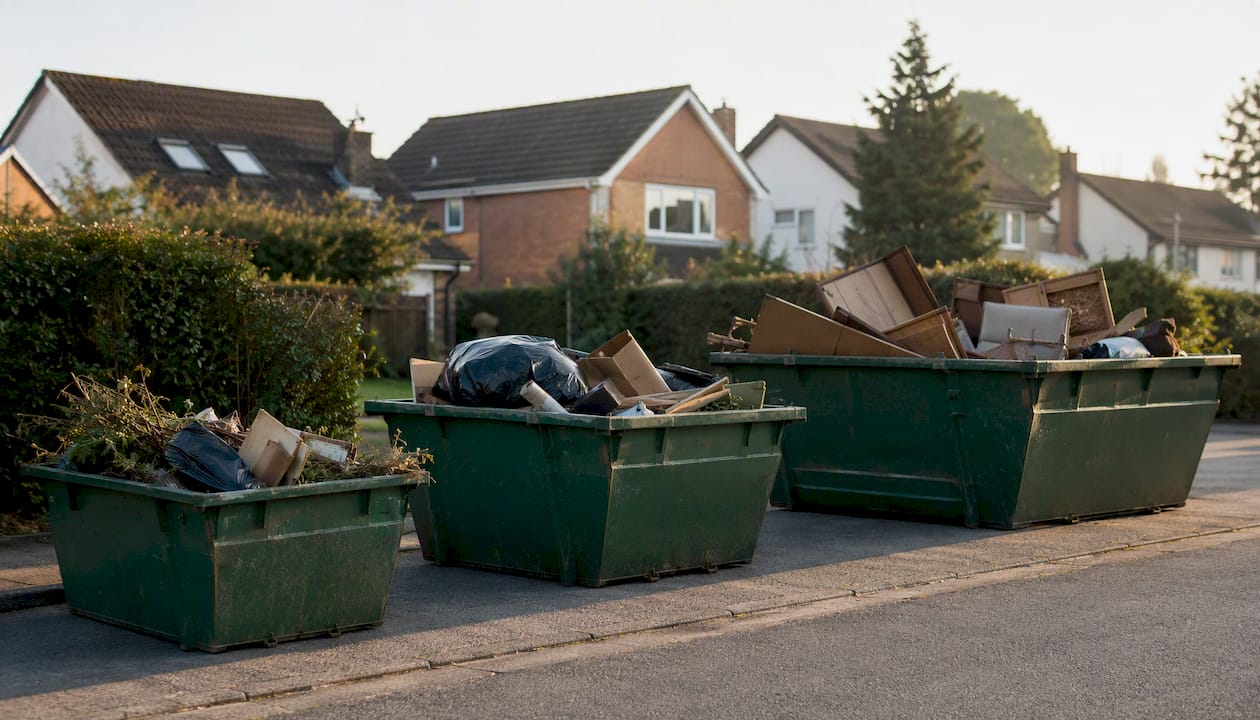
Weight limits apply separately from volume. A 4 m3 bin carries a weight cap that depends on the supplier and waste type. Heavy materials like soil, tiles, and concrete fill weight limits long before they fill volume limits, so a 2 m3 heavy-waste bin is often the smarter choice for dense materials than a larger general bin.
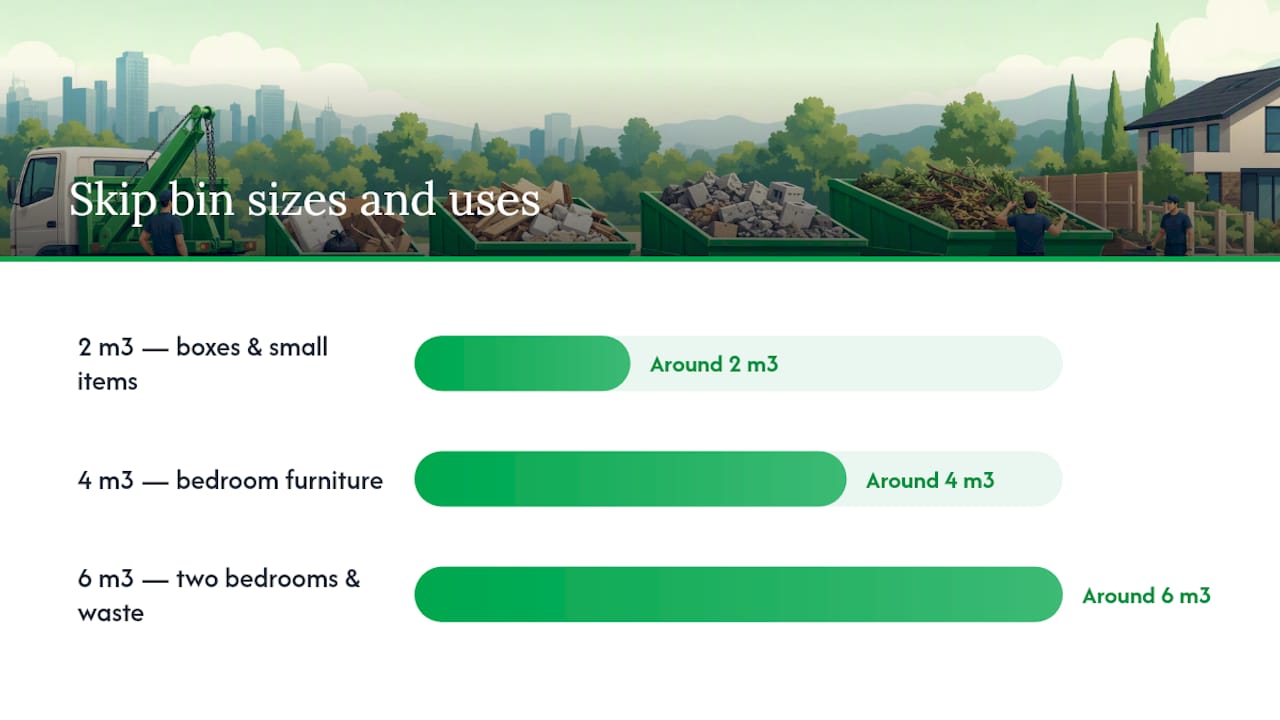
Postcode-matched suppliers also matter here. Pricing, available sizes, and weight allowances vary by location, so a bin listed at 4 m3 in one area may have different inclusions than the same size elsewhere.
Why getting your m3 right actually matters
Most people treat the cubic metre as a technicality. After working with skip bin bookings and removals across Australia, the pattern is clear: the readers who take ten minutes to calculate their m3 estimate properly almost never need a second bin or a return trip.
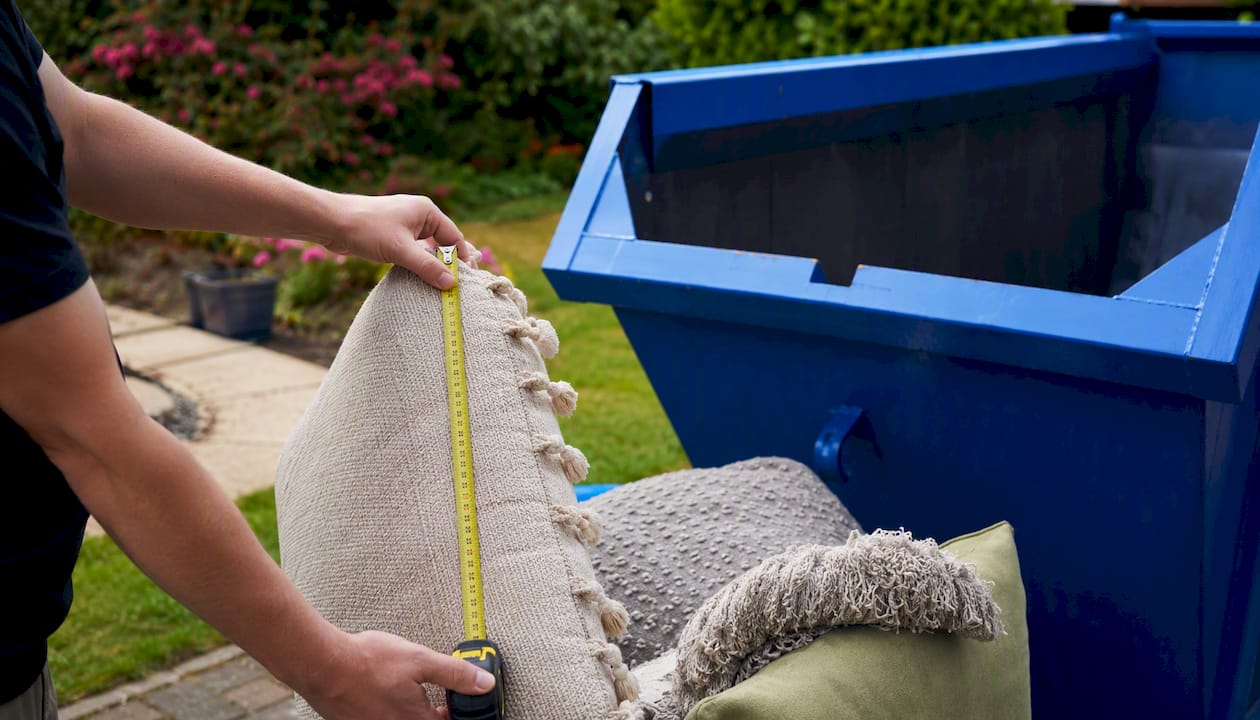
The math is simple, but the discipline is what counts. Measuring bounding boxes, applying a packing buffer, and checking weight limits against volume limits are habits that prevent the two most common and costly mistakes: undersizing (which means a second booking fee) and oversizing (which means paying for capacity you never use). Accurate m3 estimates also make it easier to compare quotes across suppliers, because you are comparing the same volume, not guessing at what “medium bin” means to each company.
Book a skip bin matched to your m3 estimate
Once you know your volume, finding the right bin should be just as straightforward. Localskipbinhire connects you with postcode-matched local suppliers across Australia, so the sizes and pricing you see are specific to your area, not a national average.

Enter your postcode, select the m3 size that matches your estimate, and compare local skip prices before you book. Pricing is all-inclusive (delivery, pickup, and disposal), and labour-included options are available if you need a hand with loading. For a typical household cleanout or renovation, a 4 m3 skip covers most jobs. If your estimate sits closer to 2 m3, a postcode-matched 2 m3 bin is available in most areas. Check what is available at your address and book in minutes.
Sources
Recommended
What those sizes cost once you have your number
Volume tells you which bin to book; it does not tell you the price, and the two do not move together. Typical prices from our supplier network, checked August 2026:
| Size | Melbourne typical | Brisbane typical |
|---|---|---|
| 2 m3 | $298 | $334 |
| 4 m3 | $543 | $541 |
| 6 m3 | $743 | $656 |
| 10 m3 | $1,113 | $1,125 |
Two things fall out of that. A 10 m3 holds five times a 2 m3 but costs under four times as much, so the 10–20% packing buffer is far cheaper to carry than a second booking. And the 4 m3 lands within a couple of dollars across both cities while the 6 m3 does not come close — 4 m3 is a volume, not a price. Compare Melbourne, Brisbane, or every size nationally on the price index, then price your own postcode. Figures shift with tip levies.
← Older Post Newer Post →