

Do You Need a Skip Bin Permit in Australia?
Brett Taylor en skip bin permits australia
You need a council permit only if any part of the skip bin sits on public land, such as a road, nature strip, footpath, or parking bay. A bin placed entirely on your driveway or lawn generally needs no permit at all.
If your project means the bin has to go on the street, don’t book placement until the permit is sorted. Ask your supplier whether they handle the application (most do) or check your council’s permit portal yourself.
Before you call a supplier, gather:
- A photo of the proposed spot
- Your preferred delivery and pickup dates
- The supplier’s ABN
- A copy of the supplier’s public liability insurance certificate
Public liability insurance of $20 million is the standard most councils expect suppliers to carry, and a council will not issue a permit without proof of it on file.
Key Takeaways
Skip bin permits in Australia are required whenever any part of the bin sits on public land, and most councils expect the supplier, not the homeowner, to lodge that application.
| Point | Details |
|---|---|
| Public land triggers a permit | A bin on the road, nature strip, or footpath needs council approval; private property doesn’t. |
| Suppliers usually apply | Councils like Knox and Boroondara expect the supplier to lodge the application, not the resident. |
| Insurance is non-negotiable | Suppliers typically need $20 million public liability insurance naming the council as an interested party. |
| Timelines vary widely | Processing windows run from 3 to 14 business days depending on the council. |
| Fees differ by council | Daily placement fees range from around $31 to over $100 per parking bay, so check your local rate. |
Table of Contents
- What Counts as Public Land Under Skip Bin Permit Requirements
- How to Get a Skip Bin Permit: The Application Process
- Council Safety Conditions: Clearance, Visibility, and Placement Hours
- Who’s Liable: Supplier Responsibilities and What Happens if You Skip the Permit
- What a Skip Bin Permit Actually Costs and How Long It Takes
- Your Pre-Booking Checklist Before You Order a Skip Bin
- How Localskipbinhire Takes the Guesswork Out of Permits
- Why the Permit Conversation Usually Happens Too Late
- Sources
What Counts as Public Land Under Skip Bin Permit Requirements
Public land covers anything outside your title boundary, meaning the road, footpath, nature strip, or a formal parking bay out front. Councils treat these spaces as shared infrastructure, not an extension of your yard, and that’s the entire basis for skip bin regulations Australia wide.
Some situations trip people up. A driveway is private property, but a bin that overhangs the footpath by even a few centimeters counts as public land encroachment. Construction parking zones set up for a renovation often still require a separate permit for the bin itself, even if the crew already has approval to park trucks there.
Councils restrict certain spots outright, regardless of how briefly you need the bin:
- Clearways and bus stops
- Mobility parking spaces
- Cycleways and shared paths
- Loading zones
- Areas directly over stormwater drains or utility access points
The logic isn’t bureaucratic box-ticking. Councils protect pedestrian sightlines, drainage access, and utility infrastructure, and a bin blocking any of those creates a real safety hazard, not just a paperwork problem.
How to Get a Skip Bin Permit: The Application Process
Most homeowners never touch the actual application. Boroondara and Knox both require the skip bin supplier, not the resident, to lodge the paperwork, and that’s the norm across most Victorian councils. Here’s how it typically runs:
- Check the council portal. Most councils, including those using Service Victoria integrations, list a specific skip bin permit application form separate from general road occupation permits.
- Gather site evidence. A clear photo of the intended spot or a Google Maps screenshot showing the exact placement speeds up approval.
- Confirm supplier details. The council needs the supplier’s ABN and their public liability certificate, ideally naming the council as an interested party.
- Pay the fee and wait for the PDF. Once approved, you’ll get a reference number and a downloadable permit document, sometimes followed by a site inspection.
This supplier-led approach exists for a reason. A council permit approval process run through an accredited supplier tends to move faster and hit fewer documentation snags than a one-off resident application, mostly because the supplier already has their insurance paperwork on file with that council. If you’re weighing state-specific rules, our guides to skip bin permits in Victoria and skip bin permits in South Australia break down the differences council by council.
Council Safety Conditions: Clearance, Visibility, and Placement Hours
Getting the permit is only half the job. The bin still has to sit exactly where and how the council specifies, or you risk a fine even with paperwork in hand.
Expect these standard conditions:
- At least 1.5 meters of clear pedestrian pathway around the bin
- Reflective markers or lighting so the bin is visible after dark
- Placement parallel to the kerb, within a single marked parking bay (roughly 6 meters)
- No placement on arterial or high-traffic roads under most local laws
- Restricted placement windows, commonly weekdays 7am to 7pm and Saturday 8am to 3pm in City of Melbourne
Placing a bin in the center of a busy road, rather than a marked bay, sometimes triggers the need for a formal traffic management plan, which adds cost and lead time.
Pro Tip: Measure the parking bay before you book. A bin that’s a fraction too long for a standard bay can get flagged during a council site check, even if your permit was approved based on the photo you submitted.
Who’s Liable: Supplier Responsibilities and What Happens if You Skip the Permit
Responsibility for a permitted skip bin splits fairly cleanly between supplier and homeowner, and knowing the split matters if something goes wrong.
Suppliers are generally expected to:
- Hold public liability insurance, commonly $20 million, naming the council as an interested party
- Lodge the permit application where council policy requires it
- Mark and illuminate the bin to permit conditions
- Remove the bin within the approved placement window
Skip the permit and place a bin on public land anyway, and consequences range from a fine to immediate impoundment of the bin. Damage to council assets, a cracked footpath or blocked drain, for instance, can also leave you or the supplier liable for repair costs. That liability risk is one reason managing renovation waste properly matters as much as picking the right bin size.
What a Skip Bin Permit Actually Costs and How Long It Takes
Processing windows and fees vary by council, and the gap between the cheapest and most expensive options is bigger than most homeowners expect.
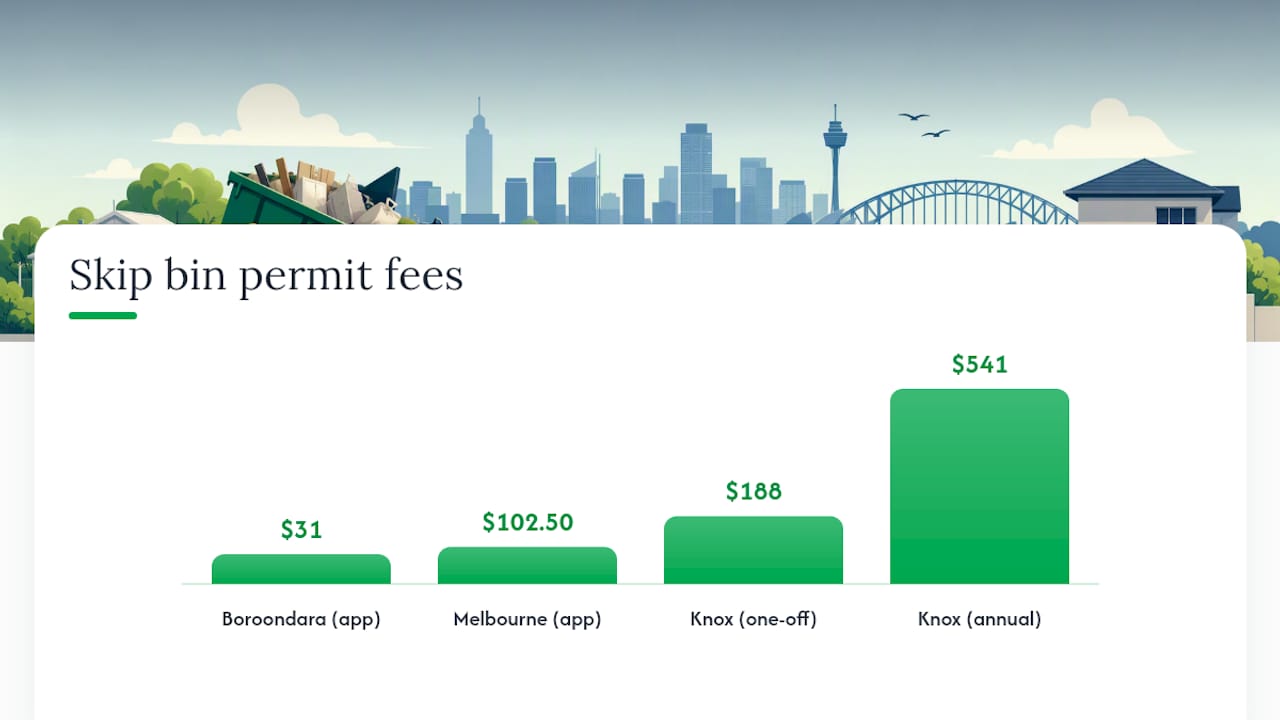
Typical processing times run 3 to 14 business days. Brimbank and Willoughby generally require at least 10 business days’ notice, while Knox asks for up to 14 days for a one-off permit.
Fees swing just as widely:
- Boroondara charges a $31 application fee plus $31 per day placement
- City of Melbourne charges $102.50 application plus $102.50 per parking bay per day
- Knox offers accredited suppliers an annual permit (around $541) with instant approvals, versus a $188 one-off permit for occasional use
Applying at short notice or asking for out-of-hours placement often costs more, and some councils will simply refuse a rushed request outright.
Your Pre-Booking Checklist Before You Order a Skip Bin
Run through this before you lock in a delivery date, and you’ll avoid most of the delays that catch homeowners out.
- Decide whether the bin will sit entirely on private property or needs to touch public land.
- If public land is involved, ask your supplier directly whether they’ll lodge the permit application.
- Take a photo or Google Maps screenshot of the exact spot, and measure clearance from the kerb, driveway, and any street furniture.
- Check for underground utilities or stormwater pits near the proposed spot.
- Talk to your neighbors if the bin will sit outside their property line, even briefly.
- Confirm the supplier’s insurance and, where relevant, their accredited-provider status with your council.
- Book early enough to cover your council’s stated processing window, not the shortest one you’ve read about.
Pro Tip: Save your permit PDF and the supplier’s insurance certificate to your phone. If a council officer or curious neighbor asks, having proof on hand settles the question in seconds.
Prohibited materials can also delay a job if a bin gets flagged during inspection, so it’s worth checking what can and can’t go in a skip bin before loading day.

How Localskipbinhire Takes the Guesswork Out of Permits
Localskipbinhire matches you to local suppliers by postcode, and most of those suppliers already handle permit applications and hold the public liability insurance councils expect. That means less time chasing paperwork and more certainty that the supplier quoting you can legally get a bin approved in your council area.
Every booking shows delivery, pickup, and waste removal costs upfront, so you’re not blindsided by a supplier who quietly assumes you’ll cover permit fees separately.
- Postcode-matched suppliers who understand local council conditions
- Insurance and accreditation details visible before you book
- All-inclusive pricing with no hidden delivery or pickup add-ons
- Over 15 years connecting Australian homeowners with compliant local suppliers
| What You Get | Why It Matters |
|---|---|
| Local supplier matching | Suppliers already familiar with your council’s permit process |
| Transparent pricing | Delivery, pickup, and waste removal bundled into one quoted price |
| Insurance visibility | Confirms the supplier can legally obtain a permit before you commit |
Ready to book? Browse skip bin hire options in Box Hill, check out flexible pay-later options if you’d rather spread the cost, or set up a commercial account if you’re managing multiple properties or regular renovation projects.
Why the Permit Conversation Usually Happens Too Late
Most homeowners think about permits after they’ve already picked a bin size and a delivery date, which is backward. The permit question, private property or public land, should be the first thing you settle, not an afterthought you scramble to fix once a supplier says they can’t deliver on your chosen day.
The conventional advice out there treats permits as a minor formality, a box to tick. It isn’t. Councils like Brimbank and Knox built processing windows of 10 to 14 business days for a reason: they’re checking insurance, assessing safety conditions, and protecting infrastructure that belongs to everyone on the street, not just you.
What actually matters is sequencing. Confirm placement first. Ask your supplier about their permit process second. Book the delivery date third. Do it in that order and the fees, roughly $31 to $100-plus per day depending on your council, become predictable rather than a surprise. Skip the sequence, and you’re the homeowner staring at an impounded bin and a fine that dwarfs what the permit would’ve cost.
— Brett
Sources
- Skip bin permits | Brimbank
- Skip Bin Permit | City of Boroondara
- Skip bin permits | Knox
- Place skips, bins or containers on the road | City of Melbourne
Recommended
- A Guide to Permits and Regulations for Skip Bin Placement in Australia – Local Skip Bin Hire
- Skip Bin Permits SA: Who Needs One and How to Apply
- What Can (and Can’t) Go in a Skip Bin in Australia – Local Skip Bin Hire
- News – Local Skip Bin Hire
Why a per-day permit fee hits small bins hardest
Councils meter the footpath by the day, not by the cubic metre: the same charge applies whether a 2m³ mini or a 6m³ builder's bin sits out front. That makes the permit a fixed overhead, and it weighs heaviest on the cheapest hire. Typical general-waste prices from our live city pages, checked August 2026:
| City | Typical 2m³ | Typical 6m³ |
|---|---|---|
| Sydney | $341 | $911 |
| Brisbane | $334 | $656 |
| Perth | $311 | $646 |
| Adelaide | $246 | $502 |
Against an Adelaide 2m³, a few kerbside days are a real share of the job; against a Sydney 6m³ they barely register. Two things follow: if the driveway takes the bin you pay none of it, and if you are buying street days anyway, sizing up adds nothing on the council side. Full ladders sit on the Adelaide and Sydney cost pages and the national price index; confirm your own postcode in the price checker.
← Older Post Newer Post →